The answer is yes—but this should be an evolution, not a sudden rebuild. Belgium’s 74–93 World Cup quarter-final defeat to host nation Germany ended another impressive run in the last eight, yet it also exposed why the Belgian Cats must give their next wave greater responsibility. The core that delivered consecutive EuroBasket titles remains highly capable. However, the route to another major medal will depend on how quickly younger players can become reliable contributors beside, and eventually beyond, the established leaders.
For basketball followers in India, the Belgian Cats offer a particularly interesting example of a successful national team at a crossroads: a side with a world-class centrepiece, a proven system and a growing need to spread both minutes and decision-making.
What happened in the World Cup quarter-final?

Belgium arrived in Berlin with momentum. The Cats won Group C with three victories, including an 80–68 result against Australia, and advanced directly to the quarter-finals. That group-stage performance showed their familiar strengths: connected ball movement, versatile front-court play and poise from their experienced guards.
The quarter-final against Germany was different. Belgium started brightly and led for much of the opening quarter, but Germany’s second-quarter surge created a gap that the Cats could not close. The final score was 74–93.
Emma Meesseman scored 29 points, while Maxuella Lisowa-Mbaka added 11 points, and Julie Allemand and Kyara Linskens scored 10 each. The numbers underline the central issue: Belgium had production, but not enough balanced scoring or defensive control to withstand Germany’s pressure and shot-making.
It was not a collapse of the Belgian programme. Reaching the quarter-finals at a third consecutive World Cup confirms Belgium’s place among the sport’s leading teams. Still, a third straight World Cup quarter-final exit naturally raises a tougher question: can the current group take the next global step without a more forceful generational transition?
The Belgian Cats’ golden core is still valuable
A generational change is often described as replacing veterans. In Belgium’s case, that would be too simplistic. The present core has earned time and trust.
Meesseman remains the team’s defining player: a scorer, rebounder and elite decision-maker who can organise an offence from multiple areas of the court. Against Australia in the group stage, she recorded 22 points, 10 rebounds and eight assists. Her ability to read a defence makes teammates better, not merely her own statistics stronger.
Julie Allemand remains vital as a playmaker. Her seven assists against Australia took her World Cup total to 111, a tournament record. Julie Vanloo brings creativity and tempo, while Kyara Linskens supplies interior presence, screening and rebounding. Antonia Delaere adds defensive intelligence and important off-ball value.
This group should not be pushed aside merely to make room for youth. It is still the standard the next generation must reach.
The challenge is more practical: Belgium cannot rely on the same experienced names to solve every difficult possession, carry every scoring drought and absorb every pressure situation. The World Cup loss made that dependence visible.
Why the next generation must receive meaningful minutes
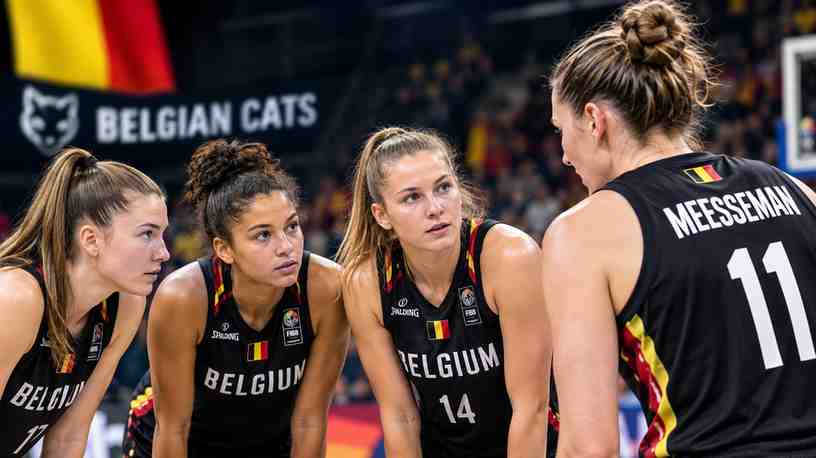
The Belgian Cats have already shown that the talent pathway exists. In a EuroBasket qualifying match in Lithuania in November 2025, Belgium fielded a young side without its established golden starting five. The young Cats narrowly lost 73–69, but they won three quarters and led by 11 points during the game.
That performance mattered because it was not simply a youth exhibition. Players including Elise Ramette, Nastja Claessens, Bethy Mununga, Becky Massey and Maxuella Lisowa-Mbaka were asked to handle real international pressure.
The lesson is not that the younger group is ready to replace Meesseman, Allemand, Vanloo, Delaere and Linskens immediately. Few national teams can replace such a decorated five without a drop in level. The lesson is that Belgium’s emerging players need games in which their choices matter.
A bench player who enters only when a game is already decided cannot easily develop the calm required for a World Cup quarter-final. A player who starts qualifiers, closes tight matches and learns from tactical mistakes can.
Players who can shape the transition
The future should not be framed around one “next Meesseman.” That is an impossible comparison. Belgium’s best route is to develop a deeper, more adaptable collective.
| Player | What she can bring to the next cycle |
|---|---|
| Nastja Claessens | A young front-court option who has already been trusted in senior international settings. |
| Elise Ramette | Guard depth, defensive energy and experience within the senior Belgian setup. |
| Maxuella Lisowa-Mbaka | Athleticism and scoring potential; her 11 points against Germany showed she can contribute in a high-stakes game. |
| Becky Massey | Experience, versatility and an established place within the national programme; she reached 100 international appearances against Australia. |
| Billie Massey | Front-court depth and a useful link between the established group and the younger cohort. |
| Bethy Mununga | Physicality, rebounding and the ability to impact games without needing a high shot volume. |
| Alicia Courthiau | A newer senior-roster option who can benefit from continued exposure to elite competition. |
The key word is “collective.” Belgium do not need every young player to become a superstar. They need several to become dependable international-level options with specific strengths: a guard who can pressure the ball, a wing who can defend and shoot, a forward who can switch defensively, and a reserve centre who can protect the paint.
That kind of depth can make Belgium less predictable and less dependent on a single scoring source.
What should change tactically?
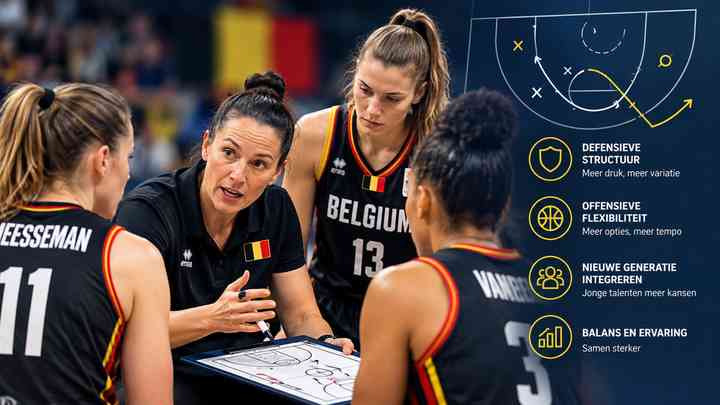
Belgium’s identity should stay rooted in intelligent passing and a team-first approach. The Cats are at their best when the ball moves quickly, their bigs operate as playmaking hubs and their guards create advantages before the defence is set.
But the next phase requires a few refinements.
Develop secondary creators
When opponents load up on Meesseman or disrupt the initial action, Belgium need more players who can create a quality shot late in the clock. Allemand and Vanloo offer high-level creation, but the next generation must learn to make reads against set defences too.
This does not mean forcing young guards to imitate veteran stars. It means giving them structured opportunities to run pick-and-roll actions, initiate transition and close selected qualifiers.
Build more defensive versatility
Germany’s victory highlighted the danger of allowing an opponent to dictate pace and space. Belgium will benefit from line-ups that can switch selectively, recover to shooters and protect the rim without losing mobility.
Young wings and forwards who can defend multiple positions are especially important in modern international basketball, where elite teams attack mismatches relentlessly.
Make the bench a true weapon
The Australian victory offered a better template. Belgium received contributions across the rotation, with Vanloo, Allemand, Delaere, Linskens and Meesseman all influencing the game in different ways. A sustainable contender needs that balance more often.
The goal should be a second unit that changes the rhythm of a game—not one that simply protects the starters’ rest.
EuroBasket Women 2027 is the natural proving ground
Belgium are co-hosts of EuroBasket Women 2027, with their group-stage games scheduled for Antwerp. That provides both opportunity and pressure.
As co-hosts, the Cats are already assured of a place in the tournament. This gives the coaching staff a valuable runway through the qualifying window. Belgium can still compete seriously in every match while using the period to test combinations, identify closing line-ups and expand the responsibilities of emerging players.
The 2027 tournament should not be treated solely as a defence of the 2025 title. It should be the start of a new competitive cycle: one in which the established leaders remain central, but the supporting cast arrives with genuine tournament experience.
Home support can help, but it will also raise expectations. The best preparation is not a dramatic reset; it is deliberate integration.
Is a full rebuild the right answer?

No. A full rebuild would discard too much quality and continuity.
Belgium have won EuroBasket in 2023 and 2025, collected four medals in their last five European Championships, and remain capable of beating top opposition. The World Cup elimination is disappointing precisely because the standard is now so high.
The smarter approach is a phased handover:
- Keep the elite core involved for major tournaments.
- Give younger players substantial roles in qualifiers and preparation games.
- Build line-ups that can succeed without Meesseman carrying every offensive burden.
- Use the EuroBasket 2027 cycle to identify the next long-term leaders.
That approach protects Belgium’s medal chances while making the programme more resilient.
The verdict: a new generation is coming, but it needs a bridge
The Belgian Cats do have a new generation. The question is whether the programme will give it enough competitive responsibility before the veterans eventually step back.
The loss to Germany should be viewed as a warning rather than a verdict. Belgium’s experienced stars remain among the best in Europe, and their knowledge is an advantage no young team can replicate overnight. Yet the next group must be allowed to make mistakes, solve problems and win meaningful games now.
If Belgium manage that balance, the Belgian Cats generatiewissel will not be remembered as the end of a golden era. It could become the reason that era lasts longer.
Frequently asked questions
Why were the Belgian Cats eliminated from the 2026 World Cup?
Belgium lost 74–93 to Germany in the quarter-finals in Berlin. Germany used a decisive second-quarter run and maintained control through the second half.
Did Belgium perform poorly throughout the World Cup?
No. The Cats won all three Group C games, beating Türkiye, Puerto Rico and Australia, before losing to Germany in the quarter-finals.
Is Emma Meesseman still Belgium’s key player?
Yes. Meesseman remains Belgium’s most influential all-round player. She scored 29 points in the quarter-final loss to Germany and was central to Belgium’s group-stage success.
Who are the young Belgian Cats players to watch?
Nastja Claessens, Elise Ramette, Maxuella Lisowa-Mbaka, Becky Massey, Billie Massey, Bethy Mununga and Alicia Courthiau are among the players who can influence the next cycle.
Will the Belgian Cats play at EuroBasket Women 2027?
Yes. Belgium are co-hosts and will play their group-stage matches in Antwerp. The tournament offers an important chance to blend the proven core with the emerging generation.