Belgian banks enter 2026 from a position of financial strength, but their competitive position is more nuanced than headline profitability suggests. The country has a stable, well-regulated banking system led by four large institutions—KBC, BNP Paribas Fortis, Belfius and ING Belgium. Together, they hold roughly 70% of Belgian banking assets, giving the market scale and resilience but also raising legitimate questions about consumer choice, pricing pressure and innovation.
For Indian readers following European banking, considering business links with Belgium, or assessing financial-sector opportunities, the key takeaway is simple: Belgian banks are robust and profitable, yet domestic competition remains concentrated. Digital challengers, specialist lenders and European regulation are gradually widening choice, but they have not displaced the major incumbents.
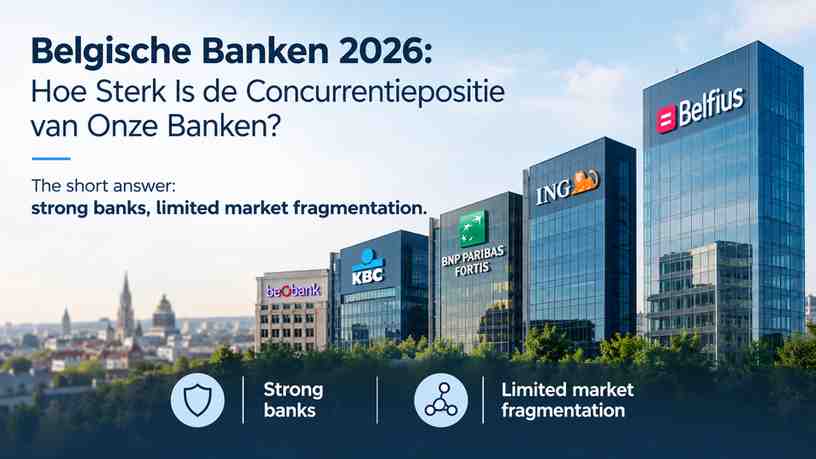
The short answer: strong banks, limited market fragmentation
The competitive position of Belgian banks is strong in three important ways:
- The largest banks have deep customer relationships, recognised brands and extensive distribution.
- They benefit from well-developed digital banking platforms and a mature payments market.
- Belgium operates within the euro area, the EU Banking Union and a strict supervisory framework.
However, competition is less intense than in highly fragmented banking markets. Four major groups dominate retail banking, mortgages, corporate banking and payment services. The Belgian Competition Authority has previously described retail banking as highly concentrated and noted that savings-rate competition was slower and weaker than in several neighbouring eurozone markets during the period of rising European Central Bank rates.
That does not mean Belgian customers have no alternatives. Argenta, Crelan, Beobank, Keytrade Bank, MeDirect, vdk bank, Aion and foreign digital providers provide choice in selected products. But the established banks remain difficult to challenge because they combine current accounts, lending, savings, insurance, investment products and business banking under one relationship.
Who leads the Belgian banking market in 2026?
The central competitive group remains KBC, BNP Paribas Fortis, Belfius and ING Belgium. Their positions vary by product, region and customer type.
| Bank or group | Core competitive advantage | Areas where it is particularly relevant |
|---|---|---|
| KBC | Strong bank-insurance model and digital ecosystem | Retail banking, business clients, insurance, investments |
| BNP Paribas Fortis | Backing of a large international banking group | Retail, corporate finance, investment banking, cross-border clients |
| Belfius | Strong local presence and public-sector relationships | Retail, public-sector financing, mortgages, business banking |
| ING Belgium | International expertise and established digital banking capability | Retail, affluent customers, businesses and international clients |
| Crelan and Argenta | More focused domestic alternatives | Savings, mortgages, retail banking and value-led offers |
| Digital and specialist providers | Lower-cost or product-specific propositions | Investing, savings, payments and online banking |
Based on 2024 total-asset market-share figures disclosed by Belfius in 2026, KBC held about 20%, BNP Paribas Fortis 19%, Belfius 14% and ING 13%. Crelan and Argenta were materially smaller. Those figures underline why the top four remain the reference point for any discussion of concurrentie Belgische banken.
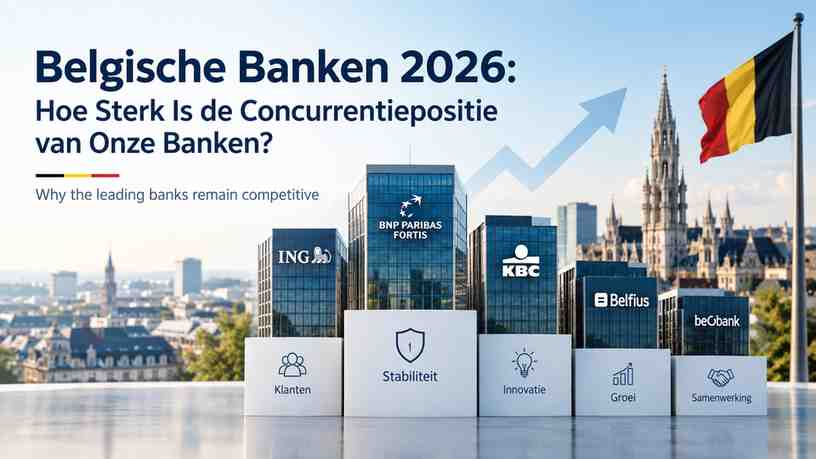
Why the leading banks remain competitive
Scale creates a meaningful advantage
Scale matters in banking because regulatory compliance, cybersecurity, anti-money-laundering controls, technology investment and risk management are expensive. Large Belgian banks can spread these fixed costs across millions of customers and wide product ranges.
This makes it difficult for a smaller competitor to match an incumbent everywhere at once. A challenger may offer an attractive savings account, trading platform or app, but many households still prefer a bank that can also handle salary payments, mortgages, insurance, cards and investment advice.
BNP Paribas Fortis benefits from the resources and international client base of BNP Paribas. KBC combines banking with insurance, which can improve customer retention and cross-selling. Belfius has strong domestic roots, while ING’s international network remains valuable for customers with cross-border needs.
Digital banking is now a basic expectation
Belgian consumers are accustomed to digital banking, instant card payments and app-based account management. The major banks are therefore not defending themselves against technology from a purely traditional branch model; they already have mature mobile and online services.
The competition is increasingly about the quality of the digital experience:
- How quickly can a customer open or switch an account?
- Are transfers, cards and security controls simple to manage?
- Can users compare savings, investments and borrowing in one app?
- How transparent are fees and interest rates?
- Does the bank offer reliable support when a payment, card or security issue occurs?
Digital capability protects the incumbents, but it also lowers barriers for fintechs and online banks. Customers can now hold a main current account with one bank, a higher-yield savings product with another and investments with a third provider. This “multi-banking” behaviour is an important source of competitive pressure.
Trust and supervision remain powerful differentiators
Belgium’s banks operate under national and European supervision. The National Bank of Belgium supervises relevant institutions and works within the broader European supervisory architecture. Deposit protection rules, capital requirements and resolution planning matter enormously to household confidence.
For consumers, a strong competitive position is not only about an attractive app or a promotional interest rate. It also depends on whether a bank can withstand economic stress, protect customer data, maintain payment availability and lend responsibly.
European-wide supervisory data have continued to show solid capital and liquidity conditions across the EU banking sector. This is not a guarantee that every institution faces identical risks, but it supports the view that Belgium’s larger banks are operating within a resilient framework.
Where competition is weaker
Savings rates and price transparency
One of the clearest concerns in Belgian retail banking has been the speed at which changes in central-bank rates reach savers. When policy rates rose, the Belgian Competition Authority found that the pass-through to savings rates had been slow and incomplete relative to several neighbouring countries.
This is an important competitive test. Customers often compare mortgage rates closely, but they may pay less attention to the difference between regulated savings accounts, term deposits and promotional offers. Banks with established customer bases can benefit when switching is inconvenient or when pricing is difficult to compare.
For consumers, the practical lesson is to compare the full return, conditions and withdrawal rules rather than assuming a long-standing bank automatically offers the best savings deal.
Switching remains possible—but not effortless
A healthy banking market needs customers to be able to move easily. Belgium has account-switching arrangements, but practical barriers still exist: linked payments, debit mandates, mortgage relationships, insurance products, investment accounts and customer habits can discourage change.
This is why specialist providers often compete on one product rather than attempting to replace a customer’s primary bank relationship immediately. A household may move savings or investments first, then consider broader banking changes later.
Concentration can reduce urgency
A concentrated market does not automatically mean poor service or excessive pricing. Larger banks can invest more in security, technology and product depth. Yet when a few institutions serve most customers, the pressure to compete aggressively can be lower—particularly in products where customers rarely switch.
The strongest sign of real competition is not simply the number of banks licensed in Belgium. It is whether consumers can compare offers easily, move money without friction and receive visibly different propositions on price, service, credit access and digital quality.
The challengers changing the market

The competitive landscape is not static. Several forces are pushing Belgian banks to improve.
Specialist domestic banks
Banks such as Argenta and Crelan can compete effectively by focusing on straightforward retail banking, savings and lending. Their smaller scale can be an advantage when they target customers who prefer simple pricing or a more focused proposition.
Other providers serve particular needs. Keytrade Bank and MeDirect are recognised in digital investing and savings, while vdk bank appeals to customers looking for a values-led banking proposition. Beobank has a presence in consumer finance and card-related products.
These banks may not rival the largest four in total assets, but they can shape market pricing and customer expectations.
Fintechs and EU-wide digital providers
European payment rules and open-banking infrastructure have made it easier for technology-led providers to offer payment, budgeting and investment services. Foreign digital banks can also serve customers across borders where local eligibility and product terms allow.
Their impact is most visible in user experience, fee visibility and product unbundling. A traditional bank no longer competes only with another full-service bank. It may compete with a mobile-wallet provider for payments, an online broker for investments and a digital lender for short-term credit.
The limitation is trust and breadth. Fintechs often need to prove long-term service quality, regulatory reliability and customer support before they can win a customer’s primary banking relationship.
Can Belgian banks compete beyond Belgium?
The answer differs by institution. BNP Paribas Fortis is connected to one of Europe’s largest banking groups. ING is part of a major international banking group, and KBC has important operations in Central and Eastern Europe. Belfius is more closely tied to Belgium, though that domestic focus can be a strength in local retail and public-sector relationships.
At the European level, Belgian banks face a scale challenge. US and Chinese banks often have much larger capital-markets franchises, while several European rivals operate in far bigger home markets. The European Commission’s 2026 banking competitiveness agenda reflects the wider concern that Europe needs a more integrated, efficient banking sector to finance investment and compete globally.
For Belgian banks, success will depend on more than domestic market share. They need strong technology platforms, disciplined cost management, cyber resilience, access to capital markets and the ability to support businesses that operate across borders.
What this means for Indian investors, students and businesses

For most Indian consumers, Belgian retail banks are not a direct alternative to Indian banks because account eligibility, residence requirements, local documentation and euro-area regulations apply. The topic becomes relevant in specific situations:
- Indian professionals relocating to Belgium may need a local current account and euro payment access.
- Indian exporters or importers dealing with Belgian partners may value banks with international trade-finance capability.
- Students and residents should compare account charges, card conditions, mobile access and cash-withdrawal terms before opening an account.
- Investors tracking Europe’s financial sector should distinguish domestic market concentration from the international reach of each banking group.
A Belgian bank should not be chosen only because it is large. For a newcomer, the practical questions are whether the bank supports the required identification process, offers English-language assistance where needed, provides affordable euro transfers and has convenient digital support.
Outlook: competition will improve, but slowly
Belgian banking in 2026 is unlikely to be transformed overnight by one new entrant or a sudden wave of switching. The major banks have strong capital positions, trusted brands, sophisticated digital channels and broad customer relationships.
Still, pressure is building. Customers expect better savings returns, clearer fees, instant digital service and easier access to competing products. Fintechs and specialist banks do not need to replace the large incumbents to influence them; they only need to make customers more willing to compare and switch.
The most likely outcome is gradual change: stronger digital competition, more product-specific switching and greater regulatory attention to transparency. Belgium’s banks remain competitively strong, but the best measure of future success will be whether that strength delivers better value and more choice for customers.
Frequently asked questions
Are Belgian banks safe in 2026?
Belgian banks operate under Belgian and European banking supervision, capital rules and deposit-protection arrangements. Safety should still be assessed bank by bank, but the sector benefits from a robust EU regulatory framework.
Which banks dominate Belgium’s banking market?
KBC, BNP Paribas Fortis, Belfius and ING Belgium are the dominant large banking groups. Together, they account for roughly 70% of total banking assets based on 2024 market-share data disclosed in 2026.
Is there enough competition among Belgian banks?
There is competition, particularly in mortgages, digital services, savings and specialist products. However, retail banking remains concentrated, and regulators have raised concerns about weak savings-rate pass-through and limited switching pressure.
Can an Indian citizen open a Belgian bank account?
It depends on residency status, identification, visa or work situation, and the bank’s own policies. Indian citizens moving to Belgium should check account eligibility directly with the bank before relying on a particular option.
Are digital banks a serious threat to Belgium’s large banks?
They are a growing competitive force, especially in payments, savings, investing and app-based service. However, the large Belgian banks retain advantages in trust, lending, insurance, compliance infrastructure and broad product coverage.