The gemeenten Vlaanderen conflict is not one single dispute. It is a recurring tension between Flemish municipalities, which deliver services closest to residents, and the Flemish regional government, which sets many of the rules, targets and funding conditions those municipalities must follow.
The discussion escalates whenever local authorities feel they are being asked to deliver more—housing, integration, climate action, mobility, welfare and public safety—without enough predictable money, staff capacity or room to adapt policies to local conditions. Flanders, meanwhile, argues that common standards are necessary to address region-wide challenges fairly and effectively.
For readers trying to understand the debate, the key issue is simple: who decides, who pays, and who is accountable when policy outcomes fall short?
The institutional backdrop: local autonomy with regional oversight
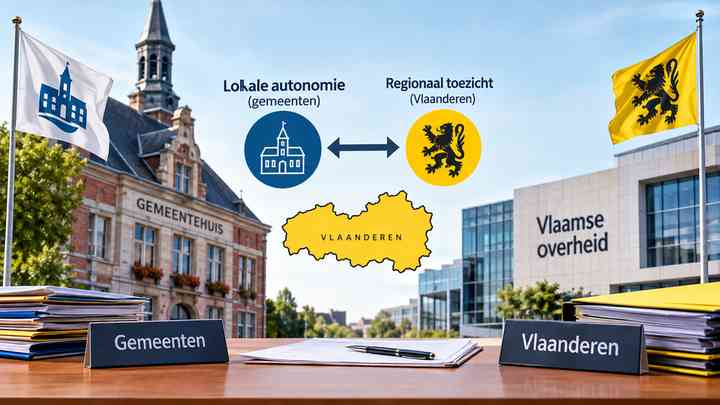
Flanders has 285 municipalities following the municipal mergers that took effect on 1 January 2025. Municipal councils can regulate matters of local interest, including local budgets, municipal property, staffing structures and local regulations. But municipalities also carry out duties imposed by the Flemish, federal and provincial levels of government. Flanders’ overview of municipal powers makes that dual role clear.
This creates an unavoidable overlap:
| Level | Main role | Typical source of friction |
|---|---|---|
| Municipality | Turns policy into services residents can use | Wants flexibility for local needs |
| Flemish Government | Sets rules, targets, funding programmes and supervision | Wants consistent results across Flanders |
| Federal Government | Controls areas such as parts of social security, policing and registration | Decisions can create local costs |
| Province/intermunicipal bodies | Support or coordinate services across municipalities | Can add another layer of responsibility |
Municipalities are not simply local branches of Flanders. They have democratic mandates and powers of their own. Yet they operate within a wider legal and financial framework. That balance between autonomy and coordination is where the conflict begins.
Why the discussion is becoming sharper
1. More responsibilities are landing at the local level
Municipalities are often expected to make broad policies work in practice. A regional housing goal, environmental rule or integration programme becomes real only when local officials, social services, planning departments and councillors translate it into decisions on the ground.
The challenge is that municipal capacity varies enormously. Larger cities may have specialist teams for planning, data, procurement and social policy. Small and rural municipalities may have much leaner administrations while facing the same complex legislation.
This difference matters because a rule that appears practical from a regional perspective can be costly or difficult to implement locally. Municipal leaders therefore argue that Flanders should assess not only whether a policy goal is desirable, but also whether each municipality can realistically deliver it.
2. Funding often comes with conditions, while costs remain local
Money is central to the gemeenten Vlaanderen conflict. The Gemeentefonds, or Municipal Fund, provides general financing designed to support local policy and partly compensate for unequal tax bases between municipalities. Unlike a narrow project subsidy, general financing gives municipalities more freedom to decide local priorities. Flanders explains the fund and its distribution framework here.
However, many policy areas rely on targeted grants, temporary programmes or co-financing. This can create three practical problems:
- A municipality receives funding for a new initiative but must later cover ongoing staff or maintenance costs itself.
- Different programmes have separate conditions, reporting rules and deadlines.
- A new obligation may arrive without enough funding to meet it at the expected quality level.
The Flemish Association of Cities and Municipalities (VVSG) has repeatedly argued that local authorities need clearer information about the budgetary impact of higher-level decisions. That concern becomes especially important when municipalities are planning for several years ahead. VVSG’s analysis of the Flemish budget noted that general municipal funding rose in 2025, while other funding changes and savings could still affect local services.
The dispute is therefore not always about the absence of money. It is often about whether the funding is stable, flexible and sufficient for the responsibility attached to it.
3. Housing targets expose the gap between ambition and delivery
Housing is one of the clearest examples of why tensions escalate. Flanders faces pressure to add homes, use land more efficiently and expand social housing. Municipalities must help find sites, issue permits, manage local opposition, coordinate with housing providers and protect public space.
These goals can conflict locally. A municipality may support more affordable homes but struggle with limited land, infrastructure constraints, flood risks, heritage rules or resident opposition. It may also believe that the regional plan does not sufficiently reflect its local population, mobility network or services.
VVSG has argued that social-housing objectives must be realistic and paired with adequate resources, workable instruments and legal certainty. Its position is not that municipalities should avoid responsibility, but that penalties alone do not create homes. Its 2025 annual report stresses the need for feasible targets and support for both construction and maintenance.
This explains why debates about housing quickly become debates about power: Flanders seeks faster progress across the region, while municipalities ask who bears the operational and political cost.
4. Local decision-making can be constrained by regional planning rules
Spatial planning is another flashpoint. Municipalities handle local permits and know the practical impact of new projects. But they must work within Flemish planning law, environmental requirements and regional policy objectives.
The pressure is increasing because Flanders needs additional housing while trying to preserve scarce open space. In 2025, Flemish Environment Minister Jo Brouns said the region would need to reconcile major housing needs with denser development and more careful use of land. VRT NWS reported on the policy debate and permit procedures.
For municipalities, the difficulty is not merely legal. They face residents directly when a project changes traffic, parking, green space or neighbourhood character. When Flanders sets direction but a municipal council carries the local backlash, political friction is almost inevitable.
5. Accountability is divided across several layers of government
Residents usually see the municipality first. If a permit is delayed, a service is hard to access or a policy does not work, they contact the town hall. But the cause may lie partly in regional law, federal financing or intermunicipal coordination.
This fragmented accountability can make public debate more heated. Municipalities may say they are blamed for decisions they did not fully control. Flanders may respond that local administrations must implement existing rules consistently.
Supervision adds another sensitive element. Municipalities are subject to oversight by higher authorities, and serious governance problems can lead to intensified supervision. The case of Sint-Truiden showed how regional oversight can become prominent when concerns about administration and integrity emerge; the enhanced supervision was lifted in 2025 after the city addressed recommendations. VRT NWS covered the decision and background.
Oversight is necessary for legality and public trust. Still, it can be perceived locally as interference if the rules are unclear or if municipalities feel they have too little opportunity to shape them.
Municipal mergers: efficiency versus local identity
The 2025 mergers reduced the number of Flemish municipalities from 300 to 285. Flanders supports voluntary mergers as a way to strengthen administrative capacity and improve service delivery. The official municipal-government page lists the 13 new merger municipalities.
Supporters believe mergers can provide larger professional teams, stronger finances and better capacity for complex tasks. Critics fear that local identity, accessibility and village-level priorities may be weakened.
The controversy around some mergers shows why this subject reaches beyond management efficiency. Residents may feel that a merger changes their political voice, local services and community identity. Flanders frames mergers as voluntary scale-building; opponents may question whether financial incentives make the choice fully free in practice.
Why multi-year plans have raised the stakes
After the 2024 local elections, all 285 municipalities prepared multi-year plans for 2026–2031. These plans set strategic priorities and financial choices for the new local governing period. The Flemish government confirmed the planning framework in 2025.
This timing makes disagreements more serious. Municipalities must decide now how much they can invest in roads, climate adaptation, welfare, sports, culture and digital services. If regional policies or grants change after local plans are approved, councils may have to cut programmes, raise local taxes or postpone investment.
Predictability is therefore almost as important as total funding. Municipal leaders need to know which commitments are permanent, which are temporary and what new obligations are likely to arrive during the planning period.
What could reduce the gemeenten Vlaanderen conflict?
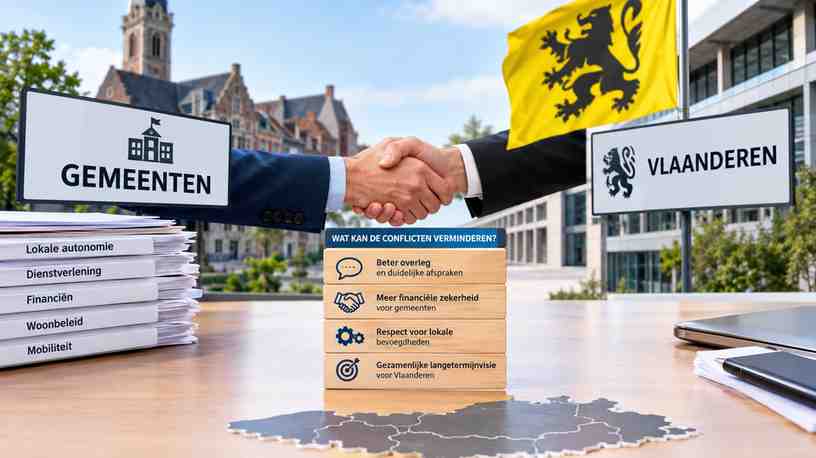
A durable solution does not require choosing either total local freedom or complete regional control. It requires clearer cooperation.
First, Flanders should involve municipalities earlier when designing regulations that require local delivery. Consultation should happen before rules are final, not only after implementation problems emerge.
Second, every major new duty should come with a transparent estimate of costs, staffing needs and administrative workload. If municipalities are expected to co-finance a policy, the split should be explicit.
Third, more funding should be stable and flexible where possible. Targeted grants can be useful, but municipalities need room to solve problems that differ from one place to another.
Finally, policy objectives should distinguish between unwillingness and inability. A municipality that refuses to act is different from one blocked by land shortages, staffing gaps or legal constraints beyond its control.
The bottom line
The conflict between municipalities and Flanders is escalating because both levels are pursuing legitimate goals from different positions. Flanders wants consistent action on challenges that cross municipal borders. Municipalities want enough autonomy, money and capacity to serve residents effectively.
The real test is whether regional ambitions can be matched with local implementation. If responsibilities keep moving downward without clear funding and workable flexibility, the debate will remain tense. If Flanders and municipal leaders treat each other as policy partners—rather than merely funder and implementer—the relationship can become more constructive.
FAQ
What does “gemeenten Vlaanderen conflict” mean?
It refers to tensions between Flemish municipalities and the Flemish regional government over local autonomy, financing, policy targets, regulation and administrative oversight.
Do Flemish municipalities have their own powers?
Yes. Municipal councils decide on matters of municipal interest, such as local policies, budgets and regulations. They also execute tasks assigned by Flemish and federal authorities.
Why is funding such a major issue?
Municipalities often deliver services required by higher-level policy. The dispute arises when funding is temporary, restricted, delayed or insufficient to cover the real long-term cost of implementation.
Are municipal mergers compulsory in Flanders?
The current Flemish policy supports voluntary mergers. Financial incentives and administrative support are available, but the decision process can still be politically contentious within affected municipalities.
How do planning and housing create conflict?
Flanders sets broad housing, environmental and land-use priorities, while municipalities must manage permits, infrastructure and local resident concerns. The regional goal and the local reality do not always align.
Can Flanders intervene in a municipality?
Yes. Municipalities are subject to administrative supervision. In serious cases involving governance or legal concerns, oversight can be intensified, although intervention is not the normal day-to-day arrangement.