The short answer is that Muslim integration in Belgium has become more visible, more politically contested and more formally regulated since 2001. Belgium has expanded language, employment and anti-discrimination measures, while public debate has increasingly focused on security, religious expression and social cohesion.
However, it is misleading to treat Muslims as one uniform group or to define integration simply as “fitting in.” Belgian Muslims include citizens whose families have lived in the country for generations, recent migrants, students, professionals, refugees and people with very different languages, ethnic backgrounds and levels of religious observance. Their experiences also vary greatly between Brussels, Flanders and Wallonia.
For Indian readers following European migration and multiculturalism, Belgium offers an important case study: formal equality and integration programmes can improve participation, but discrimination, residential inequality and polarised public debate may still limit equal opportunity.
Why 2001 became an important reference point
The events of 11 September 2001 did not create Belgium’s Muslim population or its integration challenges. Islam had already been officially recognised by the Belgian state decades earlier, and Muslim communities were well established, particularly in Brussels and major industrial cities.
But 2001 changed the tone of public discussion across Europe. Debates about immigration, religion and national identity became more strongly linked to concerns about terrorism and radicalisation. This had a direct effect on how Muslim identity was discussed in politics, media and workplaces.
A key consequence was the tendency, often challenged by equality bodies and civil-society organisations, to blur distinctions between ordinary Muslim citizens, religious conservatism and violent extremism. Since then, one of Belgium’s central integration challenges has been ensuring public security without collectively treating a diverse religious community as a security issue.
Integration moved from informal support to structured regional policy
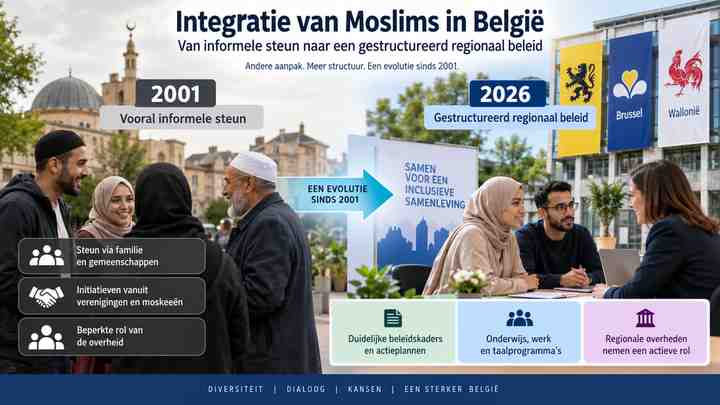
Belgium’s complex federal structure matters. Integration is not managed through one simple national system. Regions and language communities have major responsibilities, so expectations and programmes differ across the country.
Since the early 2000s, civic-integration pathways have become more structured. These commonly include:
- Language learning in Dutch or French
- Guidance on employment, housing and public services
- Information about rights, duties and Belgian institutions
- Social-orientation courses for eligible newcomers
Flanders developed a particularly formal civic-integration model, with obligatory elements for many newcomers. In Wallonia and Brussels, the approach has evolved differently, reflecting distinct linguistic, political and demographic realities.
This is one of the biggest changes since 2001: integration is now more likely to be treated as a policy process with courses, referrals and measurable participation, rather than solely as a matter for families, local associations or municipalities.
The strength of this approach is that it can make practical information easier to access. Its limitation is that language training and orientation alone cannot remove barriers such as employer bias, unequal school outcomes or neighbourhood segregation.
Employment has improved in focus, but inequality remains
Work is one of the clearest measures of social participation. Since 2001, Belgian institutions have invested more attention in labour-market gaps affecting people of migrant origin. Monitoring reports have documented improvements in employment for some groups over time, but they also continue to identify structural segmentation and persistent disparities.
This matters because integration is not only about learning a language or obtaining legal residence. It is also about whether people can convert education, skills and ambition into stable employment.
For many Muslims in Belgium, especially those perceived as visibly Muslim, access to work can still be shaped by assumptions about names, ethnicity, dress or religion. Muslim women who wear a headscarf may face an additional and intersectional barrier: discrimination connected to both gender and religious expression.
The debate over workplace “neutrality” illustrates the difficulty. Some employers and institutions rely on neutrality policies that restrict visible religious symbols. Supporters argue this protects impartial public-facing service; critics argue that broad restrictions can exclude qualified Muslim women from employment. Belgian and European case law has made clear that the legal assessment depends heavily on the policy’s consistency, purpose and application.
The major shift since 2001 is therefore not that employment equality has been fully achieved. It is that the problem is now better documented, more openly debated and more frequently addressed through equality law, monitoring and workplace-diversity initiatives.
Anti-discrimination protections became more central
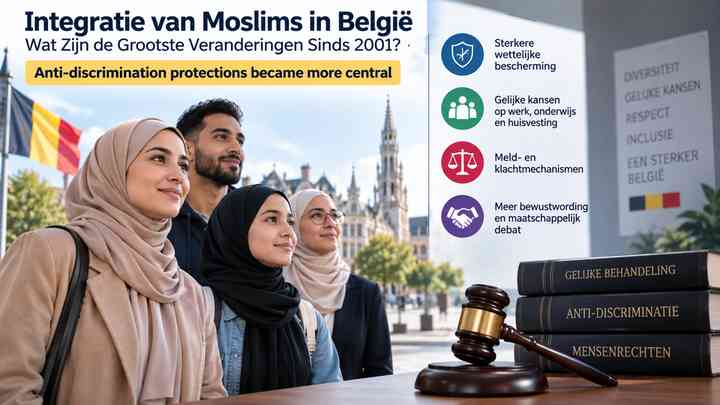
Belgium already had laws against racism before 2001, but legal protection against discrimination became more prominent during the following decades. The 2007 anti-discrimination framework strengthened protections linked to religion or belief and other protected characteristics.
Unia, Belgium’s equality body, has played an important role by handling reports, publishing data and supporting awareness of discrimination in areas such as employment, housing, education and access to services. Its recent reporting continues to show that racial discrimination remains a substantial concern.
This development changed the integration conversation in an important way. Earlier discussions often placed the responsibility almost entirely on migrants or minorities to adapt. Today, there is greater recognition that integration is reciprocal: individuals must be able to participate, while institutions and the wider society must provide fair access and enforce equal treatment.
That does not mean discrimination cases are easy to prove or resolve. Many people may not report an incident, and a single complaint cannot show the full scale of a problem. Still, stronger reporting mechanisms and public data make exclusion harder to dismiss as merely anecdotal.
Religious visibility became a more contested issue
Since 2001, religious expression has become more prominent in Belgian public debate. The most visible issue has been Islamic clothing, especially headscarves in schools, public institutions and workplaces.
Belgium does not operate with one universal rule for every school or employer. Policies can vary by institution, region and sector, which creates a complex landscape for Muslim women and girls. Debates about face coverings have also led to national restrictions in public spaces.
These questions are often presented as a choice between religious freedom and secularism. In practice, the situation is more complicated. Belgium protects freedom of religion, but it also recognises competing concerns including public order, institutional neutrality and equal access to services.
The most constructive interpretation of integration avoids simplistic conclusions. A Muslim woman wearing a headscarf may be a Belgian-born university graduate, a public-service user, an entrepreneur or a job seeker. Treating clothing as a shortcut for judging integration misses the economic, educational and civic realities of people’s lives.
The 2015–2016 security period reshaped public trust
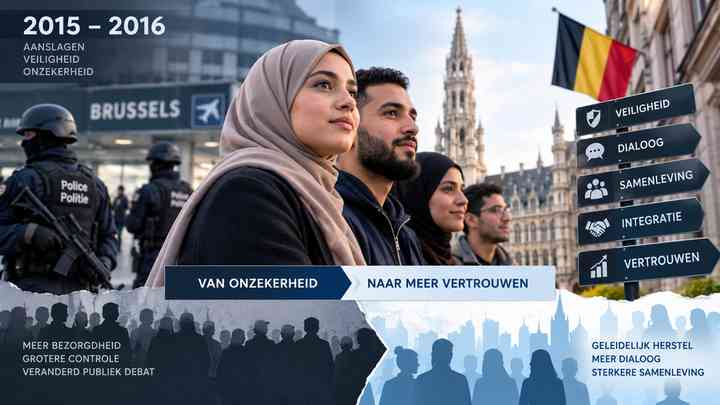
The attacks in Paris in 2015 and Brussels in March 2016 had a profound effect on Belgium. They intensified counter-terrorism policies, international cooperation and prevention efforts focused on radicalisation.
Security measures were necessary responses to genuine threats. Yet this period also placed Muslim communities under intensified public scrutiny. Many Belgian Muslims experienced pressure to demonstrate loyalty or publicly distance themselves from crimes they had not committed.
Over time, prevention policy has increasingly acknowledged that local actors matter: teachers, youth workers, families, municipal services and community organisations can identify vulnerabilities and support inclusion before problems deepen. European policy has also stressed prevention of radicalisation alongside social inclusion.
The lesson is important: effective security policy targets violent conduct and credible risks, not an entire faith. Collective suspicion can damage trust, discourage cooperation and undermine the inclusion that prevention strategies need.
A stronger focus on racism and anti-Muslim discrimination
Belgium’s approach has gradually moved toward more coordinated anti-racism action. Federal measures adopted for the 2021–2024 period built on Belgium’s long-standing commitments against racism. More recently, Belgium launched its first inter-federal action plan against racism, bringing different levels of government into a shared framework.
This coordination matters because education, employment, policing, housing and integration are spread across different Belgian authorities. A fragmented system can leave gaps even where individual laws or programmes are sound.
The broader European discussion has also changed. Anti-Muslim racism is increasingly recognised as a specific form of prejudice that may intersect with racism, gender discrimination and socioeconomic disadvantage. That is more precise than treating all problems faced by Muslims as only “migration issues.”
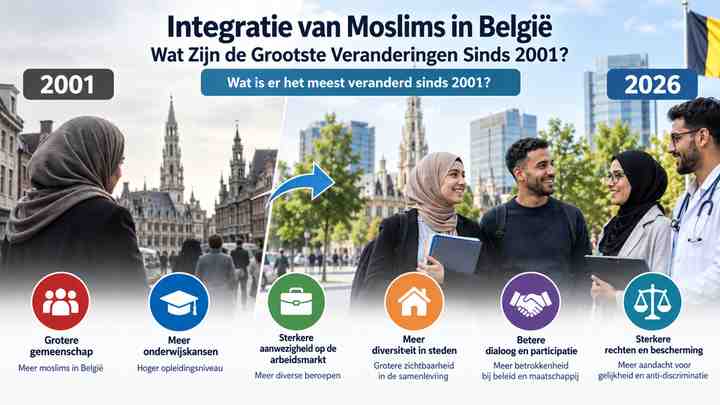
What has changed most since 2001?
| Area | Main change since 2001 | What remains unresolved |
|---|---|---|
| Integration policy | More organised language, orientation and participation pathways | Different regional systems can be difficult to navigate |
| Employment | Better data, diversity policy and legal awareness | Employment gaps and hiring discrimination persist |
| Legal protection | Stronger anti-discrimination framework and reporting channels | Legal remedies do not capture every experience |
| Religious expression | Far more public and legal debate around Islamic dress | Rules vary, and equal access remains disputed |
| Security | Greater focus on counter-radicalisation after 2015–2016 | Risk of stigmatising wider Muslim communities |
| Public debate | Muslims are more visible in civic, political and cultural life | Polarisation and anti-Muslim prejudice continue |
Is integration in Belgium better today?
In some respects, yes. Muslim citizens and organisations have greater visibility, discrimination is more openly recognised, and integration services are more developed than they were in 2001. Belgium also has clearer equality institutions and more detailed labour-market monitoring.
But progress is uneven. Legal status, education and language skills do not automatically remove bias in recruitment, housing or public life. Young people born and educated in Belgium may still encounter questions about belonging that their non-minority peers rarely face.
The most accurate conclusion is that Belgium has moved from a narrower idea of assimilation toward a more complex, rights-based understanding of integration. The country has not fully resolved the gap between formal equality and lived equality.
What Indian readers should take from Belgium’s experience
Belgium shows that diversity policy works best when it does not reduce people to religion or origin. Language education, access to jobs, anti-discrimination enforcement and local participation need to work together.
It also shows why broad labels are risky. “Muslims in Belgium” describes millions of individual experiences, not a single culture or level of integration. A fair assessment should look at participation, opportunity and rights—not stereotypes, clothing or headlines alone.
Frequently asked questions
What does “integratie moslims België” mean?
It refers to discussions about how Muslims participate in Belgian society through education, work, language, citizenship, civic life and equal access to public institutions.
Did 2001 introduce new Belgian laws targeting Muslims?
2001 was more of a political and social turning point than a single legal starting point. It changed public debate across Europe, while Belgium’s later integration, anti-discrimination and security policies evolved over several years.
Are Muslims legally protected against discrimination in Belgium?
Yes. Belgian anti-discrimination law protects religion or belief, alongside other protected characteristics. People can seek information or support from bodies such as Unia when they believe they have faced discrimination.
Why is the headscarf debate important in Belgium?
It affects access to education and employment for some Muslim women. The debate involves religious freedom, institutional neutrality and equal opportunity, with rules varying by employer, school or public body.
Has the Brussels attack changed Muslim integration policy?
The 2016 attacks increased attention to terrorism prevention and radicalisation. They also intensified public scrutiny of Muslim communities, making it especially important to separate security concerns from assumptions about ordinary Muslim citizens.
Is integration policy the same throughout Belgium?
No. Belgium’s regions and language communities have important responsibilities, so integration routes and requirements differ between Flanders, Brussels and Wallonia.