The question behind “Moslims in België: Hoe Is Integratie de Afgelopen 25 Jaar Veranderd?” is often framed too simply. Integration is not a single score, and Muslims in Belgium are not one uniform community. They include Belgian-born citizens, long-settled families, recent arrivals, people with roots in North Africa, Türkiye, South Asia, the Middle East, sub-Saharan Africa and elsewhere, as well as people with very different languages, education levels and religious practices.
Over roughly the past quarter-century, integration has become more visible and more structured. Belgium has expanded language learning, civic-orientation and employment-support routes for newcomers. At the same time, many Muslim Belgians are no longer newcomers at all: they are students, professionals, entrepreneurs, voters and parents born and educated in the country.
Yet progress has not removed persistent barriers. Labour-market gaps, unequal housing access, school inequality and anti-Muslim discrimination still affect everyday opportunities. The most accurate answer is therefore mixed: participation and institutional support have grown, but equal treatment and equal outcomes have not kept pace everywhere.
First, what does “integration” mean in Belgium?
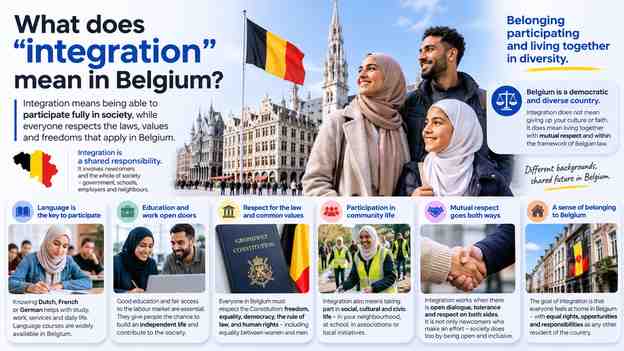
For Indian readers, it helps to separate integration from assimilation. Integration normally refers to being able to participate fully in society: learning a local language, accessing education and work, using public services, forming social networks and exercising citizenship rights. It should not require someone to abandon their faith, family history or cultural identity.
Belgium’s federal structure makes the picture more complex. Flanders, Brussels and Wallonia have different languages, institutions and integration arrangements. A person’s experience can therefore vary greatly between Antwerp, Brussels and a smaller Walloon city.
There is also an important data limitation. Belgium’s official statistics mainly track nationality and origin rather than religion. So it is inaccurate to treat every person of foreign origin as Muslim, or every Muslim as an immigrant. The national statistics office reported that, on 1 January 2024, 21.6% of residents were Belgian citizens with a foreign background and 13.7% were non-Belgians—but these categories are not measures of religious affiliation. Statbel
From settlement to a second- and third-generation reality
Around 2000, public debates about Muslims in Belgium often concentrated on migration, social cohesion and whether newcomers were “adapting.” That lens has become less adequate over time.
Today, many Muslims have deep roots in Belgium. Their integration questions are often the same as those facing any Belgian citizen: quality schooling, fair recruitment, affordable housing, career progression and the freedom to express identity without penalty. This shift matters because policies designed only for newly arrived migrants cannot solve discrimination faced by a Belgian-born graduate with a Muslim name or a woman wearing a hijab.
The country itself has also become more diverse. More residents have acquired Belgian nationality or were born Belgian to parents with foreign backgrounds. That means belonging is increasingly shaped by citizenship and participation, not simply by where a family originated.
How policy has changed: more formal pathways, stronger conditions
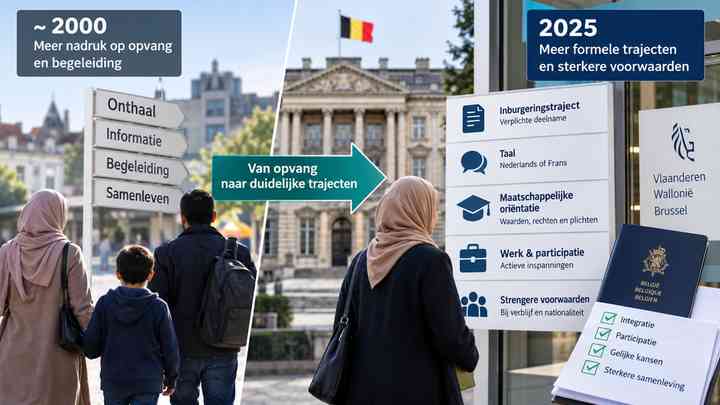
One of the clearest changes in integratie moslims België has been the move towards formal civic-integration pathways for eligible newcomers.
In Flanders, the current route includes social orientation, Dutch-language learning and individual guidance towards employment, study or diploma recognition. Some newcomer groups must complete the programme, meet attendance requirements and can face an administrative fine if they do not comply. Flanders’ official guidance
This is a substantial change from an earlier approach that relied more heavily on local initiatives and less standardised support. The contemporary system is more explicit about the link between language, employment and participation.
Belgian nationality rules have also placed greater emphasis on language ability, social integration and economic participation. Depending on the route, applicants may need to demonstrate legal residence, knowledge of a national language and evidence such as work history, training or involvement in the receiving community. Federal Public Service Justice
These policies can help people navigate Belgian institutions. However, they should not be confused with proof that integration is complete. Completing a course cannot by itself eliminate employer bias, neighbourhood segregation or unequal school outcomes.
Employment: improvement, but a meaningful gap remains
Work is central to long-term integration because it affects income, language use, confidence, housing choices and social contact. Belgium has made progress in overall employment and in employment among people of non-EU origin, but the gap remains considerable.
According to Statbel, the employment rate for people aged 20–64 with a non-EU nationality of origin reached 59% in 2025, compared with 77.4% for people of Belgian nationality. The gap had narrowed from 23 percentage points in 2003 to 18.4 points in 2025, which signals improvement without equality. Statbel’s labour-market figures
These figures are about origin, not religion, so they cannot be presented as a direct Muslim employment rate. Still, they reveal an important structural context for many Muslim-background communities.
| What has improved | What still needs attention |
|---|---|
| More language, job-search and credential-support programmes | Lower employment rates among people of non-EU origin |
| Greater participation of women in the labour market overall | Unequal access to higher-quality jobs and career advancement |
| More recognition that diversity is a labour-market issue | Discrimination during hiring and at work |
The challenge is not only getting a first job. Skills recognition, professional networks, internships and unbiased promotion processes strongly influence whether qualified people move into stable, higher-paid roles.
Education and language: the strongest long-term levers
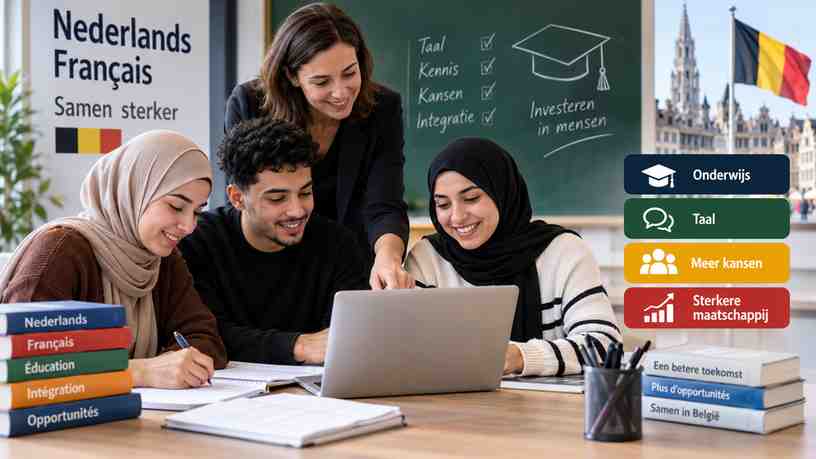
Education is where integration often becomes visible across generations. Children and young adults who grow up in Belgium usually gain stronger language skills and familiarity with local institutions than first-generation arrivals. Higher education also opens access to wider professional networks.
But outcomes remain uneven. The European Migration Network’s 2024 Belgium factsheet reported that 43.5% of third-country nationals aged 25–34 had tertiary education, compared with 51.2% of nationals. It also found a much higher early-school-leaving rate among third-country nationals aged 18–24: 17.1%, versus 6.5% for nationals. EMN Belgium country factsheet
Again, these are not Muslim-only figures. Still, they underline why a serious discussion of Muslim integration must look beyond religious identity. School support, family income, housing, language exposure and local opportunity all matter.
For Muslim families, the practical question is often not whether education is valued, but whether every child receives equal access to strong schools, guidance and pathways into further study.
Discrimination has become harder to ignore
A major change over the past 25 years is that discrimination is now more openly measured and discussed by institutions, equality bodies and EU agencies. Belgium has legal protections against discrimination, and its framework has been strengthened to address more specific and intersectional forms of unequal treatment. European Commission overview of Belgian integration policy
However, legal protection does not always translate into equal lived experience.
The EU Agency for Fundamental Rights’ 2024 report, based on a 2021–22 survey of Muslim immigrants and their descendants across 13 EU countries including Belgium, found a marked rise in anti-Muslim racism since 2016. Across the surveyed countries, 47% of Muslim respondents had experienced racial discrimination in the preceding five years, with job seeking and housing among the most affected areas. FRA report summary
Belgium’s equality body, Unia, also reported that 31% of the discrimination files it opened in 2024 concerned racial criteria, with employment, housing and healthcare identified as areas where structural discrimination can affect daily life. Unia’s 2024 figures
This means integration must be two-way. Newcomers and minority communities need accessible routes into society, while employers, landlords, schools, public institutions and the wider public must ensure that participation is genuinely possible.
Identity, religion and public life
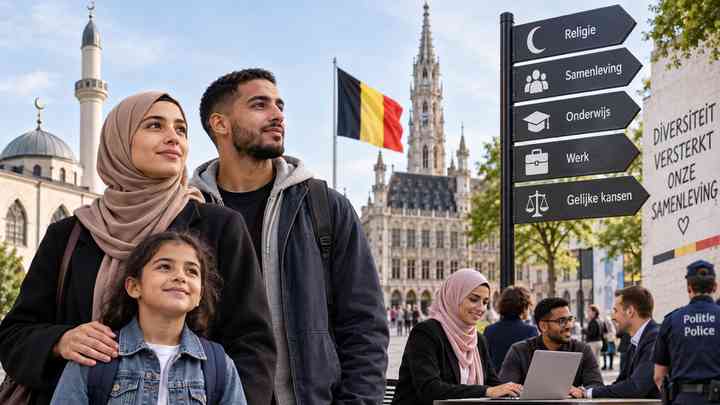
Muslim visibility in Belgium has increased through mosques, halal businesses, community organisations, cultural work and representation in local public life. This visibility can support belonging, especially when people can participate as both Muslim and Belgian without being forced to choose one identity over the other.
At the same time, issues such as religious dress, school rules, workplace policies and public rhetoric remain contested. These debates are often emotionally charged, but they should be assessed through practical questions: Does a rule apply fairly? Does it create an unnecessary barrier to education or employment? Does it protect legitimate public interests without singling out a minority?
A balanced integration policy should defend freedom of religion, women’s agency, equal opportunity and social cohesion together.
What has genuinely changed—and what has not?
The last 25 years have brought three lasting changes:
- Integration has become more institutionalised, especially through language, civic orientation and work-related support.
- The Muslim population is increasingly made up of Belgian citizens and Belgian-born generations, making “newcomer” narratives incomplete.
- Discrimination is better documented, even though it remains a serious obstacle.
The unfinished work is equally clear. Belgium needs faster recognition of qualifications, stronger school-to-work transitions, fairer recruitment and housing practices, and more reliable data on discrimination. It also needs public debate that treats Muslims as individual citizens rather than as a single social problem.
FAQ
Are all Muslims in Belgium immigrants?
No. Many Muslims are Belgian citizens, including people born in Belgium to parents or grandparents who migrated earlier. Religion, nationality and origin are different categories.
Does Belgium collect official statistics on Muslims?
Belgian official statistics primarily use nationality and origin categories, not a complete register of religious affiliation. As a result, precise national figures on Muslims are limited and estimates should be treated carefully.
Is integration compulsory in Belgium?
It depends on the region and the person’s status. In Flanders, certain newcomers are required to follow a civic-integration pathway involving social orientation, Dutch learning and employment or study guidance.
Has employment integration improved?
Yes, employment among people of non-EU origin has increased over time, and the gap with people of Belgian nationality has narrowed. But a substantial gap remains, so progress is real but incomplete.
What are the biggest barriers for Muslims in Belgium today?
Common barriers include discrimination in recruitment and housing, unequal school outcomes, language challenges for new arrivals, credential recognition and public debates around religious expression.
What is the best way to understand Moslims in België: Hoe Is Integratie de Afgelopen 25 Jaar Veranderd?
Avoid one-dimensional conclusions. Belgium has improved access to integration services and many Muslims participate fully in Belgian society. At the same time, persistent inequality shows that successful integration requires both individual opportunity and institutions that treat people fairly.