A mild Belgian winter can make mosquito nuisance last well beyond the traditional summer months. The muggenseizoen België usually begins in spring and peaks during warm, humid periods, but mosquitoes may remain active into October—and occasionally later—when temperatures stay favourable. This change matters for residents, travellers and Indian visitors because longer activity means more opportunities for bites and continued surveillance of invasive species such as the Asian tiger mosquito.
Belgium’s public-health authorities do not define one fixed start and end date for every mosquito species. Weather, daylight, rainfall, local shelter and the mosquito’s biology all influence activity. The key message is simple: a warmer season can extend mosquito activity, but it does not mean that every mosquito survives all winter or that Belgium has become a tropical disease zone.
Why mild weather can lengthen Belgium’s mosquito season
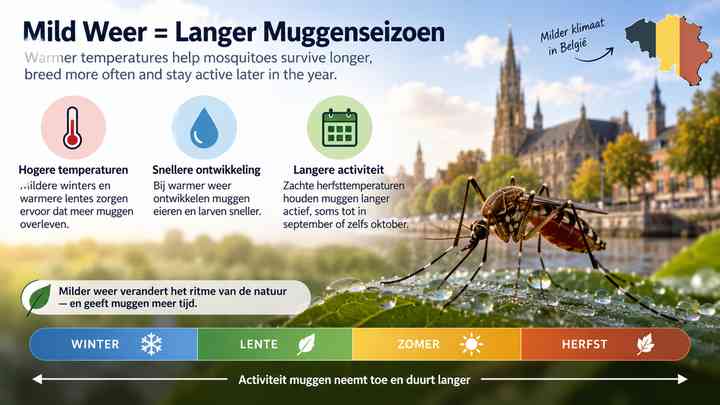
Mosquitoes are cold-blooded insects. Their movement, feeding and reproduction depend heavily on temperature. A useful rule of thumb cited by Belgian entomology experts is that mosquitoes can remain active while temperatures sit roughly between 15°C and 20°C. Activity generally drops as temperatures move consistently toward 10–15°C, although species differ.
Mild weather affects mosquitoes in several ways:
- Adults remain active for longer. Warm evenings allow mosquitoes to fly, seek hosts and lay eggs later in autumn.
- Eggs and larvae develop faster. Standing water in flowerpot saucers, gutters, buckets and rain barrels can produce new generations when temperatures remain suitable.
- Winter survival improves for some species. Native mosquitoes typically enter a dormant phase, but warmer, sheltered conditions can improve survival.
- Earlier spring emergence becomes possible. Eggs that overwinter successfully may hatch sooner when temperatures rise.
Belgian health authorities say climate change, particularly milder winters, is helping the tiger mosquito gain opportunities to survive and potentially establish itself in parts of the country. However, temperature alone is not the whole explanation. Rainfall, humidity, urban design, international transport and people’s habits also influence mosquito numbers.
What Belgian monitoring shows
Belgium has increased mosquito surveillance through Sciensano and the Institute of Tropical Medicine (ITM). In 2025, tiger mosquitoes were detected in seven municipalities from May onward, and overwintering was confirmed in three of those locations. Monitoring was scheduled to continue until the end of October because the species can remain active until then. Sciensano reported that established locations in Belgium had risen to eight when earlier findings were included. Sciensano’s 2025 update explains the findings and the role of citizen reporting.
The Federal Public Service Health also reported that tiger mosquitoes had been found in 21 Belgian municipalities during 2024, across Flanders, Wallonia and Brussels. The authority links the species’ increasing establishment opportunities to climate change and soft winters. The official 2025 season notice advises residents to remove stagnant water and report suspected sightings.
These figures do not mean that all Belgian municipalities have tiger mosquitoes. They show that introductions are recurring and that some local populations may survive winter. Traffic and goods movement can also transport mosquitoes from southern Europe into Belgium.
Common mosquito versus Asian tiger mosquito
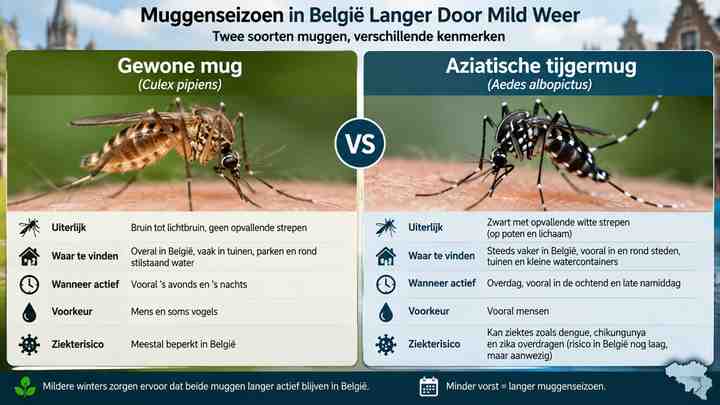
Most mosquitoes encountered in Belgium are native species. They are generally associated with damp environments and are often most noticeable around dusk and at night.
The Asian tiger mosquito (Aedes albopictus) behaves differently:
| Feature | Common Belgian mosquitoes | Asian tiger mosquito |
|---|---|---|
| Appearance | Often brown or grey, with less striking markings | Black with conspicuous white stripes |
| Typical biting time | Mainly evening and night | Frequently active during the day |
| Breeding sites | Wet ground, ponds and other water bodies, depending on species | Small containers holding stagnant water |
| Public-health concern | Usually nuisance biting | Can transmit dengue, chikungunya and Zika under suitable circumstances |
| Belgian status | Native species are widespread | Introduced and monitored; establishment varies by location |
A tiger mosquito is small—typically around 4–5 millimetres—and may appear more aggressive because it bites repeatedly during daylight. Identification from a quick glance is difficult, so take a clear photograph rather than trying to catch it.
Does a longer season mean more disease in Belgium?
Not automatically. A longer period of mosquito activity increases the window in which bites can occur, but disease transmission requires several conditions: a competent mosquito, a virus circulating in the area, suitable temperatures and contact between infected people and mosquitoes.
Sciensano currently states that dengue cases diagnosed in Belgium are imported, meaning travellers acquired the infection in regions where dengue circulates. Nevertheless, the tiger mosquito can transmit dengue, chikungunya and Zika, so authorities monitor its spread carefully. Sciensano’s dengue information stresses bite prevention, particularly for travellers returning from tropical and subtropical regions.
For Indian travellers, this distinction is important. India has endemic transmission of several mosquito-borne diseases, including dengue in many states. If you develop fever, severe headache, rash, joint pain or unusual bleeding after returning from travel, contact a doctor and mention your itinerary. Do not self-diagnose based on a mosquito bite.
What residents and visitors should do

The most effective approach combines source reduction, physical barriers and correctly used repellents.
Remove breeding water every week
Inspect balconies, gardens, terraces and shared building spaces. Empty or scrub:
- Flowerpot saucers
- Buckets and children’s toys
- Blocked gutters
- Wheelbarrows and plant trays
- Untidy rain barrels
- Outdoor furniture that collects water
- Pet bowls left outside
Tiger mosquitoes can use surprisingly small amounts of water. Cover rain barrels securely and keep containers upside down when they are not needed. Simply killing adult mosquitoes will not solve the problem if larvae continue developing nearby.
Use screens and nets
Install window and door screens, especially in bedrooms. A properly fitted mosquito net can improve sleep without relying on indoor insecticides. Keep doors closed where practical, and repair torn screens promptly.
Apply repellent safely
Use a product authorised for sale in Belgium and follow its label. Common active ingredients include DEET, icaridin (picaridin) and IR3535. Apply only to exposed skin, avoid eyes and lips, and wash treated skin when protection is no longer needed. Children, pregnant people and anyone with sensitive skin should follow age restrictions and ask a pharmacist or doctor when uncertain.
Do not assume essential-oil bracelets or untested “natural” mixtures provide reliable protection. Reapply according to the product instructions, particularly after sweating or swimming.
Dress for the conditions
Long, loose-fitting sleeves and trousers reduce exposed skin. Light-coloured clothing can make insects easier to spot, although clothing alone is not complete protection. During daytime walks, remember that tiger mosquitoes may bite even when ordinary mosquitoes are inactive.
How to report a suspected tiger mosquito
Belgian authorities rely heavily on public observations. If you see a small black mosquito with white bands on its legs or body, take a close photograph and submit it through MuggenSurveillance.be. Do not transport the insect to another location.
Reporting helps researchers distinguish a one-time introduction from a population that is reproducing locally. It also helps authorities target inspections and remove breeding sites before numbers increase.
What the extended muggenseizoen België means in practice
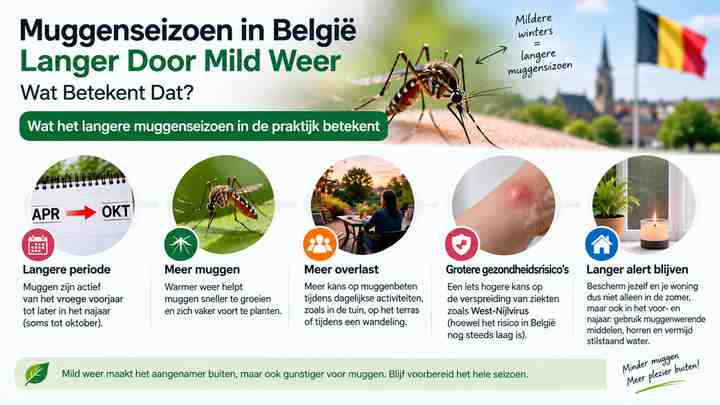
For most households, a longer season means extending normal precautions into early autumn. Keep screens in place, continue emptying outdoor containers and carry repellent for evening meals or garden work while temperatures remain mild.
For local authorities, the change means monitoring cannot focus only on July and August. Surveillance may need to continue through October, particularly in urban areas, motorway service stations, plant nurseries and transport hubs where tiger mosquitoes can arrive or find container habitats.
For travellers from India, Belgium remains a temperate destination, not a year-round tropical mosquito environment. Still, pack a proven repellent, consider accommodation with window screens and avoid leaving standing water on balconies or terraces. If you are carrying plants, camping equipment or vehicles from southern Europe, inspect them for trapped water before entering Belgium.
Frequently asked questions
When does the mosquito season usually start in Belgium?
Monitoring campaigns commonly begin in May, while ordinary mosquitoes may appear earlier or later depending on spring temperatures. There is no single national start date for every species.
Can mosquitoes really survive a Belgian winter?
Some native species overwinter in dormant stages. In addition, tiger mosquito populations have survived winter at several Belgian locations, especially where eggs or adults are protected from extreme cold.
Are mosquitoes active in Belgium in October?
They can be. Sciensano’s 2025 monitoring continued until the end of October because tiger mosquitoes may remain active until then. Activity depends on local temperatures and weather.
How can I tell a tiger mosquito from a normal mosquito?
Look for a small black body, white bands on the legs and a white stripe on the upper body. Identification is not always reliable from memory, so photograph the insect and submit it for expert review.
Should Indian tourists worry about dengue in Belgium?
The current risk is much lower than in dengue-endemic parts of India, and Belgian dengue cases are reported as imported. Nevertheless, avoid bites and seek medical advice for fever or other symptoms after travel.
Is removing stagnant water more effective than using spray?
Both measures help, but they address different problems. Repellent protects you from bites, while removing stagnant water reduces the next generation of mosquitoes. Combining them provides better protection than relying on either one alone.
Bottom line
The muggenseizoen in België is becoming less predictable and can last longer during mild, humid weather. The clearest evidence concerns increased monitoring and the tiger mosquito’s ability to survive winter in some locations. This does not mean mosquitoes are active everywhere all year, nor that local disease transmission is inevitable.
For residents and visitors, the practical response is straightforward: remove standing water, use screens, apply an approved repellent and report suspected tiger mosquitoes. Those habits remain useful whether autumn arrives early or Belgium experiences another unusually mild season.