The short answer is that Wallonia’s biggest psychiatric-capacity problem is not simply the number of beds. It is the mismatch between where specialist services are located, which patients need them, and whether a suitable next step in care is available.
For people researching Psychiatrische Instellingen in Wallonië: Waar Zijn de Grootste Capaciteitsproblemen?, three pressure points stand out: weak access in the south of Wallonia, limited specialist care for children and adolescents, and bottlenecks between hospital treatment and community-based support. Staffing shortages and incomplete real-time capacity data make each of these problems harder to solve.
Capacity in psychiatry means more than hospital beds
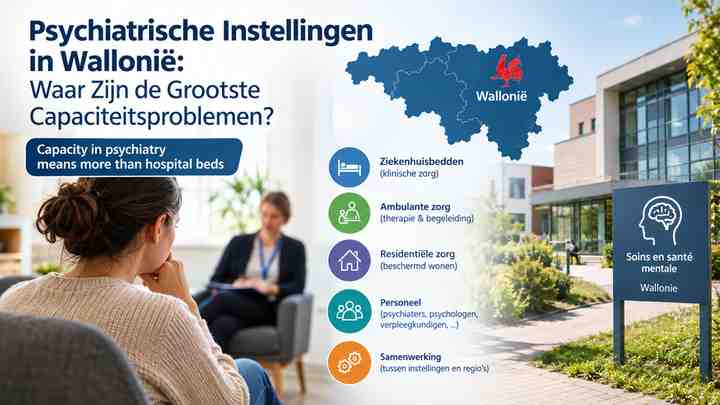
In Belgium, psychiatric care is delivered through psychiatric hospitals and psychiatric departments in general hospitals, alongside outpatient mental-health services, mobile teams, protected housing and psychiatric care homes. A bed is only one part of the pathway.
That distinction matters. A patient in an acute crisis may need rapid admission; another may need day treatment, intensive home support, addiction care, child psychiatry or supported accommodation after discharge. When the required service is unavailable, a technically vacant bed elsewhere does not necessarily solve the problem.
As of 1 January 2023, Wallonia had 115 authorised adult psychiatric beds and places per 100,000 residents across psychiatric hospitals and psychiatric units in general hospitals. That figure describes authorised capacity, not an assurance that an appropriate place, team and onward-care option are immediately available.
The most serious issue: unequal access across Wallonia
The clearest geographic imbalance concerns southern Wallonia.
Adult psychiatric hospitals and general-hospital psychiatric units are concentrated along the Tournai–Charleroi–Mons–Liège–Verviers corridor. In contrast, there are virtually no such facilities in the south of the region. This affects residents of more rural areas, particularly where travel options are limited or regular family involvement is essential to recovery.
| Area of pressure | Why it creates a capacity problem | Likely consequence |
|---|---|---|
| Southern and rural Wallonia | Specialist inpatient services are far less locally available | Long travel, delayed assessment and difficult family contact |
| Urban hospital corridors | Institutions are concentrated in a limited number of cities | Greater demand is channelled into the same facilities |
| Child and adolescent services | Care is specialised and unevenly distributed | Families may face delays or referral outside their local area |
| Step-down support | Housing and community services may not be available when hospital care ends | Longer hospital stays or unstable discharge plans |
For a person in acute distress, distance is not a minor inconvenience. It can determine whether relatives can participate in treatment, whether a person returns for follow-up appointments and whether an admission is realistic at all. Geographic capacity should therefore be measured in travel time and continuity of care, not only in bed totals.
Child and adolescent psychiatry faces particularly tight capacity

Youth mental-health care is one of Wallonia’s most sensitive pressure points. The demand is clinically different from adult care: children and adolescents may need age-appropriate inpatient units, day programmes, school continuity, family therapy and coordinated social support.
At the start of 2023, Belgium had 1,345 authorised psychiatric beds and places for children and adolescents, combining residential, day and night treatment. Wallonia’s youth services are not evenly spread. They are concentrated mainly around Charleroi, Namur and Walloon Brabant.
This concentration can create a double barrier for families living elsewhere:
- A young person may require specialist assessment before admission.
- The nearest suitable service may be far from home.
- A place in a general adult psychiatric setting is not an appropriate substitute for specialist child and adolescent care.
- Discharge may be delayed if schooling, outpatient therapy or family support cannot be organised locally.
The central problem is not that every young person requires hospitalisation. In fact, many should receive timely outpatient or community support. But when specialist inpatient treatment is necessary, the system must have a safe, age-appropriate place available without forcing families into long-distance care.
The hidden bottleneck: leaving hospital safely
A psychiatric admission should not become longer simply because a person has nowhere suitable to go next. Yet capacity outside hospital strongly affects capacity inside it.
Patients recovering from an acute episode may need supported housing, psychiatric home care, a mobile team, addiction services, day treatment or a community mental-health service. If these supports are limited, a hospital may struggle to discharge someone safely. The practical result is fewer beds available for the next person in crisis.
Wallonia has increasingly emphasised care closer to everyday life rather than unnecessary institutionalisation. That direction is important, but it only works if community options grow in step with need. Otherwise, the system can experience pressure at both ends:
- People wait longer for specialist help before an admission.
- People who are clinically ready to leave may wait for an appropriate support arrangement.
This is why counting hospitals alone gives an incomplete picture of psychiatric capacity in Wallonia.
Adult outpatient services are under sustained demand

Community mental-health services are a key part of preventing crises from escalating into hospital admissions. AVIQ data show that almost 15,000 new adult clients approached a Walloon mental-health service between 2021 and 2023.
That is not a waiting-list statistic and should not be treated as one. However, it does show the substantial volume of people seeking support through the non-hospital system.
When early intervention, psychology, social support and psychiatric follow-up are accessible, they can help people receive care in a less restrictive setting. When access is delayed, hospital emergency departments and acute units can become the default entry point for people whose needs might have been addressed earlier through continuous care.
Staffing turns authorised capacity into real capacity
A recognised psychiatric bed needs trained people around it: psychiatrists, nurses, psychologists, social workers, occupational therapists and support staff. Recruitment difficulties therefore affect operational capacity even where a bed is formally authorised.
This is a wider healthcare challenge, but psychiatry is particularly exposed because care cannot be reduced to accommodation. Safe acute care requires adequate supervision, multidisciplinary assessment, medication management, therapeutic activity and discharge planning.
There is also a national caution behind raw capacity figures. In 2023, 13.6% of authorised adult psychiatric beds and places in Belgium were temporarily taken out of service under approved arrangements. That national statistic cannot be used as a Wallonia-specific figure, but it illustrates an important point: authorised capacity and usable day-to-day capacity are not identical.
Why the data do not always show the full problem
Publicly available statistics can identify authorised beds, hospital locations and admissions. They are less effective at showing the real-time experience of patients and clinicians: which unit is full today, whether a bed is suitable for a particular diagnosis, how long a referral takes, or whether a patient can be discharged safely.
Mental-health care also crosses institutional boundaries. A person may move between a GP, emergency department, psychiatric unit, outpatient therapist, social service and supported housing provider. Without joined-up information, delays at one point in the journey can remain invisible in headline hospital figures.
For this reason, claims that Wallonia has either “enough beds” or “not enough beds” are too simplistic. The more accurate conclusion is that capacity is uneven, specialised and dependent on the availability of staff and community alternatives.
What should be prioritised?

The strongest response would focus on access and patient flow rather than only building additional inpatient beds.
1. Improve access in the south of Wallonia
Rural residents need practical routes into specialist assessment, crisis support and follow-up. That may include stronger mobile teams, transport-aware care planning, teleconsultation where clinically appropriate and local partnerships with general hospitals and primary care.
2. Expand age-appropriate youth pathways
Child and adolescent mental-health services need enough specialist inpatient and day-treatment capacity, but also faster local support for families before a crisis reaches hospital level. Education, family services and healthcare providers all have a role.
3. Strengthen discharge and supported-living options
Hospitals should not function as long-term accommodation because a patient lacks safe housing or outpatient follow-up. Protected housing, psychiatric home care and coordinated community support are central capacity investments.
4. Retain and recruit mental-health professionals
Additional places without staff will not improve access. Workforce planning should cover nursing, psychiatry, psychology and social support—not only medical posts.
5. Publish clearer capacity information
Policymakers need regular, regional information on operational beds, referral delays, staffing gaps and the availability of step-down care. Better transparency would make it easier to identify where pressure is most severe.
What this means for patients and families
For families, the right question is often not “Which psychiatric hospital has a bed?” but “Which service is appropriate for this person’s immediate needs, age, risk level and location?”
A GP, treating clinician, emergency service or local mental-health network can help identify the appropriate pathway. In a life-threatening emergency in Belgium, call 112. French-speaking suicide-prevention support is available 24/7 on 0800 32 123.
Frequently Asked Questions
Where are psychiatric services most concentrated in Wallonia?
Adult psychiatric hospitals and psychiatric units are concentrated largely along the Tournai, Charleroi, Mons, Liège and Verviers axis. Southern Wallonia has very limited local inpatient psychiatric provision.
Is the main problem in Wallonia a shortage of psychiatric beds?
Not exclusively. The main issue is a combination of uneven geography, specialist youth-care demand, staffing constraints and insufficient community support after hospital treatment.
Why is child and adolescent psychiatry under pressure?
Young people need specialist, age-appropriate care rather than a generic adult psychiatric placement. Services are unevenly distributed, while treatment often requires coordination with families, schools and social services.
Can community care reduce hospital pressure?
Yes, when it is timely and sufficiently resourced. Outpatient services, mobile teams, supported housing and follow-up care can prevent some crises and enable safe discharge after an admission.
Are authorised beds always available to patients?
No. An authorised bed may be unsuitable for a patient’s clinical needs or temporarily unavailable because of staffing and service-organisation constraints. Real operational capacity is therefore lower than a simple bed total may suggest.
What is the most important improvement for psychiatry in Wallonia?
A more balanced regional system: stronger access in rural areas, better specialist youth care, adequate staffing and reliable community support so that hospital treatment is used when needed and discharge is safe when clinically appropriate.