For Indian investors considering overseas property, vastgoed investeren in België can still make sense in 2026—but it is no longer a market where simply buying any apartment and waiting is a convincing strategy. Belgium offers a stable legal framework, an established rental market and access to major European employment centres. Yet high transaction costs, region-specific taxes, renovation obligations and cross-border tax reporting make careful property selection essential.
The short answer: 2026 can be a good time to buy Belgian real estate if you have a long holding period, sufficient cash for upfront costs, and a property-specific rental plan. It is less suitable for investors seeking quick appreciation or relying heavily on foreign financing.
What is happening in Belgium’s property market in 2026?

Belgian home prices have not collapsed, but the market has become more measured. Official Statbel data for the first quarter of 2026 showed that national house prices were 2% higher year on year, while the overall house-price index declined 0.8% from the previous quarter.
That combination matters. It suggests a market that is still broadly resilient but offers more room for negotiation than a fast-rising market. For a long-term buyer, slower price growth can be healthier than buying during a bidding frenzy.
Existing homes have remained more resilient than new homes. In the first quarter of 2026, prices for existing Belgian homes rose 3.8% year on year, while new-home prices declined 3.1%. Investors should not interpret this as a universal buying signal: location, energy performance and building condition can make a far bigger difference than national averages.
Belgium property prices: what should an Indian investor expect?
Belgium is not one uniform market. Brussels, Flanders and Wallonia differ greatly in property values, tenant demand, local rules and purchase taxes.
| Region | Median price for attached/semi-detached house, Q1 2026 | Broad investment character |
|---|---|---|
| Belgium overall | €285,000 | Useful national reference point |
| Brussels-Capital Region | €543,500 | High entry cost, international tenant base |
| Flanders | €321,318 | Broad employment base and active housing market |
| Wallonia | €200,000 | Lower entry price, but demand must be checked locally |
At an ECB reference rate of roughly ₹109.82 per €1 in early September 2026, the national median of €285,000 is approximately ₹3.13 crore before taxes and purchase costs. A Walloon house at the reported €200,000 median is around ₹2.20 crore, while the Brussels median above is roughly ₹5.97 crore.
These conversions are illustrative, not quoted purchase prices. INR outgo can change materially with EUR/INR movements, bank fees and the timing of remittances.
Why Belgium can still appeal to overseas investors

Belgium has several qualities that can suit an Indian investor with a European diversification objective.
A central European location
Brussels is a major centre for EU institutions, international organisations, consulting firms and multinational employers. Cities such as Antwerp, Ghent, Leuven and Liège have their own employment and education ecosystems. A property near practical transport links, employers or universities may have more dependable rental demand than a cheaper property in a weak micro-market.
Foreign ownership is generally possible
Belgian law does not impose a general nationality-based ban on foreign ownership of real estate. However, being allowed to buy is not the same as having easy access to a Belgian mortgage. A non-resident buyer should treat financing as a separate due-diligence exercise and obtain preliminary views from lenders before signing a binding agreement.
A mature legal conveyancing system
A Belgian notary is central to the purchase process. The notary verifies title, handles the deed and oversees important legal and tax formalities. That structure does not eliminate investment risk, but it gives buyers a clear professional route for completing a transaction.
The biggest reality check: purchase costs are high
For investment property, Belgium’s entry costs can significantly affect returns. Registration duties are set by region and should be budgeted before evaluating rental yield.
| Property location | Standard transfer/registration duty for an investment purchase |
|---|---|
| Flanders | 10% |
| Brussels-Capital Region | 12.5% |
| Wallonia | 12.5% |
Reduced owner-occupier rates may exist, but they typically depend on conditions such as making the property your principal residence. An Indian buyer acquiring a rental property should not assume those reductions apply.
Registration duty is not the only cost. A buyer should also obtain a written notary estimate covering notarial fees, administrative charges, deed-related costs and, where relevant, mortgage-registration costs. Newly built homes can follow a different tax treatment, so never use a resale-property calculation for a developer sale without confirmation.
The practical takeaway is simple: a property that looks attractive on a gross-rent basis may become unattractive once acquisition costs, vacancy, insurance, maintenance and tax compliance are included.
Flanders, Brussels or Wallonia: where should you look?
The right region depends on the investment thesis, not just the ticket size.
Brussels: stronger international demand, higher entry cost
Brussels may suit investors targeting professionals, diplomats, EU-linked employees and internationally mobile tenants. The trade-off is high acquisition cost and intense competition for well-located, compliant apartments. Focus on building quality, public transport, charges payable by the owner and the legality of the intended rental use.
Flanders: employment hubs and energy diligence
Flanders includes Antwerp, Ghent and Leuven, alongside many commuter towns. It can work well for long-term residential lets, but energy performance deserves close attention. New owners of residential homes with EPC labels E or F generally face a requirement to renovate to at least label D within six years of purchase.
A low purchase price for an inefficient home is not automatically a bargain. Add realistic renovation budgets, contractor availability and the risk of delays before deciding.
Wallonia: lower entry prices, selective demand
Wallonia can offer a lower upfront property price, especially outside prime locations. The key question is not whether the home is cheaper than Brussels or Flanders; it is whether there is durable tenant demand in that municipality. Check local employment, rail connectivity, universities, vacancy trends and resale liquidity.
How to evaluate rental returns properly
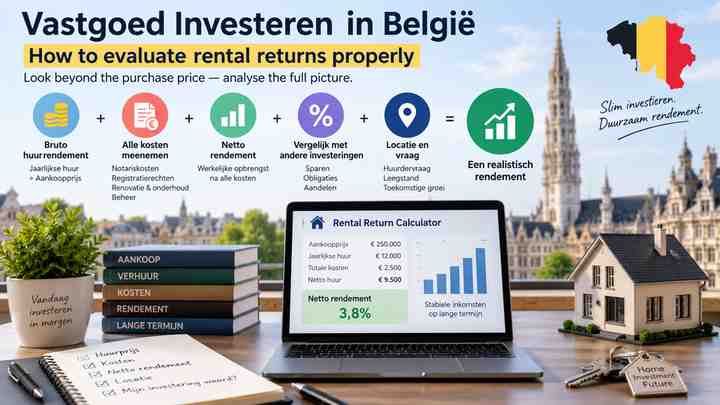
Do not rely on an advertised “yield.” Ask for the exact formula.
A sound investment calculation starts with expected annual rent and deducts:
- Registration duty and all purchase expenses spread over the intended holding period
- Property tax and owner-paid building charges
- Insurance, repairs and reserve funding
- Letting-agent or property-management fees
- Vacancy and tenant-turnover allowance
- Renovation and energy-compliance costs
- Belgian and Indian tax advice, filing and banking costs
- EUR/INR currency risk
For a non-resident investor, net income in euros can be very different from net returns in rupees. If the euro weakens against the rupee before you repatriate income or sell, your INR result may disappoint even when the local property value rises.
Tax and cross-border reporting: do not treat this as an afterthought
Belgian property income and gains can create tax obligations in Belgium. As an Indian tax resident, you may also have Indian reporting and tax considerations. The India–Belgium tax treaty provides a framework for avoiding double taxation, but it does not mean income can be ignored in either jurisdiction.
Income from immovable property may be taxed where the property is located. The treaty also provides for Indian tax relief mechanisms where Belgian tax has been paid, subject to the applicable rules and documentation.
Before purchasing, speak with:
- A Belgian notary for the transaction structure and regional costs.
- A Belgian tax adviser for non-resident rental-income and disposal implications.
- An Indian chartered accountant experienced in foreign assets, treaty relief and disclosures.
- A FEMA-compliant remittance adviser or authorised dealer bank.
This is particularly important if you plan to use a company, co-own the property with family members, or remit rental income back to India.
Due diligence checklist before making an offer
A well-priced Belgian property can still be a poor investment if its documents or operating economics are weak.
Check the following before committing:
- The Energy Performance Certificate and any mandatory renovation exposure
- Building inspection findings, roof, façade, heating, electrical and moisture condition
- Annual common-area charges and reserve funds for apartments
- Minutes of the co-owners’ association, including planned major works
- Existing lease terms, tenant deposit arrangements and rent history
- Zoning and permitted use, especially for furnished or short-stay ideas
- Property tax, insurance and local charges
- Rental comparables based on achieved rents, not only advertised rents
- Finance approval and the total INR cost after conversion and remittance charges
- Exit scenario: who is likely to buy the property in five to ten years?
For apartments, review the condominium documents with unusual care. A low unit price can conceal upcoming lift, façade, roof or heating-system expenditure shared by owners.
Who should buy Belgian property in 2026?

Belgium may suit Indian investors who:
- Want euro-denominated diversification and can hold for at least seven to ten years.
- Have enough liquidity to cover the purchase price, duties and unexpected renovation costs.
- Are comfortable using local professionals for management and compliance.
- Choose a location with identifiable, year-round rental demand.
- Value stable ownership structures more than rapid capital appreciation.
Who should skip or delay the purchase?
Consider waiting if you:
- Need high leverage but have not confirmed non-resident financing.
- Are buying purely because a property appears cheap in euro terms.
- Need immediate positive cash flow without allowing for taxes and vacancy.
- Cannot fund a potential energy renovation.
- Do not have a plan for Belgian tax filings, Indian disclosure and currency management.
- Expect a holiday-home purchase to behave like a professionally selected rental investment.
Is 2026 still a good moment to invest in Belgian real estate?
Vastgoed investeren in België in 2026 can be worthwhile, but selection matters more than market timing. The market is not showing the overheated pace that often forces buyers to compromise, while official data still points to underlying resilience in existing homes.
For Indian buyers, the strongest opportunities are likely to be properties with clear local rental demand, sound energy performance, manageable building costs and a long-term holding plan. The weakest approach is buying an old, low-priced property without pricing in Belgian transaction duties, renovation obligations and cross-border tax administration.
Treat the purchase as a euro-denominated operating asset—not simply as a foreign property to own—and 2026 can be a sensible entry point.
FAQs
Can an Indian citizen buy property in Belgium?
Generally, yes. Belgium does not have a broad nationality-based prohibition on foreign ownership of real estate. Financing, tax registration and compliance requirements can still be more complex for non-resident buyers.
How much registration duty does an investor pay in Belgium?
For a typical investment purchase, the standard rate is 10% in Flanders and 12.5% in Brussels and Wallonia. Reduced rates intended for owner-occupiers may not apply to a non-resident rental investment.
Is Brussels better than Flanders for rental investment?
Not automatically. Brussels can offer international tenant demand but has higher entry prices. Flanders can provide strong employment-linked demand in selected cities, but investors must examine location, EPC rating and renovation obligations property by property.
What does the Flemish EPC renovation rule mean for investors?
A buyer of a residential property with EPC label E or F in Flanders generally has six years from the deed to renovate it to at least label D. This potential cost should be included in the investment model before making an offer.
Will rental income from a Belgian property be taxable in India?
Indian tax residents may have Indian reporting and tax obligations for foreign property income. Belgium may also tax income connected with property located there. The India–Belgium tax treaty can provide double-taxation relief, but professional advice is essential for the buyer’s exact situation.