For anyone following the hypotheekmarkt België—the Belgian mortgage market—the central question is straightforward: do higher borrowing costs force house prices down? The short answer is not necessarily. Higher mortgage rates reduce what buyers can borrow and cool transaction activity, but Belgian property prices have remained relatively resilient because of wage indexation, limited supply, longer loan maturities and the popularity of fixed-rate mortgages.
The latest official data show a market that has slowed in some areas but has not experienced a broad crash. Statbel reported annual house-price inflation of 2.0% in the first quarter of 2026, while its House Price Index fell 0.8% compared with the previous quarter. Meanwhile, the National Bank of Belgium (NBB) recorded a strong recovery in new mortgage lending during 2025.
What is happening in the Belgian mortgage market?
Mortgage rates rose sharply after the European Central Bank (ECB) increased policy rates to combat post-pandemic inflation. The NBB notes that Belgian household mortgage rates declined from around 4% to just above 3% during the easing phase up to May 2025, but then remained broadly stable as longer-term market rates stopped falling. National Bank of Belgium analysis
In 2025, the Belgian mortgage market regained momentum:
| Indicator | 2024 | 2025 |
|---|---|---|
| New mortgage lending | €31.7 billion | €40.7 billion |
| Annual growth | About 2.0% | 3.9% |
| Average new loan, excluding refinancing | €168,656 | €187,632 |
| Share of long-term fixed-rate loans | — | 74.3% |
These figures come from the NBB’s February 2026 review of the 2025 market. NBB mortgage-market report
The increase in lending does not mean homes suddenly became cheap. It indicates that buyers and lenders adapted to the new rate environment. Some households borrowed for longer, increased their down payment or purchased a less expensive property.
Why higher mortgage rates usually push prices lower
A mortgage rate affects housing through the buyer’s monthly payment. Consider a simplified €300,000 mortgage over 25 years:
| Interest rate | Approximate monthly payment |
|---|---|
| 2.0% | €1,272 |
| 3.0% | €1,423 |
| 4.0% | €1,584 |
The difference between 2% and 4% is more than €300 every month, before insurance, property tax, maintenance and energy costs. A household that can safely spend €1,400 per month may need to reduce its borrowing by tens of thousands of euros when rates rise.
This creates several effects:
- Lower borrowing capacity: Banks calculate affordability using income, existing debts and the expected monthly payment. Higher rates reduce the maximum loan available.
- Fewer bids: Buyers who cannot stretch their budget stop bidding or postpone their purchase.
- Longer selling periods: Properties may stay on the market longer, especially if sellers initially price them using older, low-rate assumptions.
- Pressure on investors: Buy-to-let investors face higher financing costs while rents may not rise enough to compensate. Some may sell or avoid new purchases.
- Lower construction activity: New-build projects become harder to finance for both developers and buyers. The NBB reported that the share of new loans for new construction fell from 14.1% to 11.0% over two years.
In theory, these forces should reduce prices. In practice, Belgium’s market has other powerful supports.
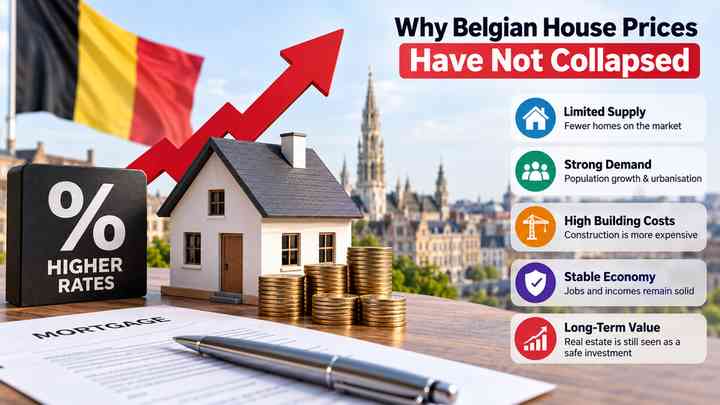
Why Belgian house prices have not collapsed
Wage indexation protects household income
Belgium’s automatic wage-indexation system has helped many employees’ incomes rise with inflation. This does not make housing cheap, but it can gradually reduce the share of income devoted to a fixed-rate mortgage.
The NBB’s affordability indicator assumes a household finances 80% of an average property with a 20-year fixed-rate loan. In 2025, the repayment burden was close to 27% of average disposable income, compared with about 23% in 2020. NBB affordability explanation
That is a meaningful deterioration, but it is not the same as widespread mortgage distress.
Most Belgian borrowers choose fixed rates
Belgian borrowers are relatively insulated from sudden payment shocks because fixed-rate mortgages dominate the market. The NBB said long-term fixed contracts represented 74.3% of average monthly lending volume in 2025. Other industry data indicate that more than 96% of newly originated loans in 2025 had fixed rates.
This structure slows the transmission of higher rates. Existing homeowners with a fixed mortgage generally keep the same monthly payment, while new buyers carry most of the burden.
Housing supply remains constrained
Belgium has strong underlying demand in employment centres such as Brussels, Antwerp, Ghent and Leuven. Building new homes is expensive and time-consuming, and planning restrictions limit rapid increases in supply.
When fewer homes are available, sellers may accept a longer marketing period rather than make a large price cut. This helps explain why transaction volumes can weaken while headline prices remain stable.
Loan terms have become longer
Some buyers respond to higher rates by extending the mortgage term. A 25-year loan has a lower monthly payment than a 20-year loan, although the total interest paid over the life of the loan is higher.
Longer terms support purchasing power in the short run, but they also mean households remain indebted for longer and build equity more slowly.
What do the latest house-price figures show?
Statbel’s House Price Index for the first quarter of 2026 recorded:
- Annual house-price inflation of 2.0%
- Average inflation over the previous four quarters of 3.0%
- A quarterly decline of 0.8%
The quarterly fall suggests that momentum softened at the start of 2026, but annual growth remained positive. Statbel’s index also distinguishes between new and existing dwellings, which is important because existing homes often respond faster to changes in buyer demand than newly built properties. Statbel House Price Index, Q1 2026
For the full year 2025, Statbel reported median prices of:
| Property type | Belgium median price |
|---|---|
| Attached or semi-detached house | €280,000 |
| Detached house | €390,000 |
Regional differences were substantial. In 2025, the median attached or semi-detached house cost about €510,000 in the Brussels-Capital Region, €317,100 in Flanders and €198,000 in Wallonia. Detached homes had median prices of approximately €1.06 million in Brussels, €430,000 in Flanders and €325,000 in Wallonia. Statbel 2025 house prices
These figures show why a single “Belgian house price” can be misleading. A rate increase may have a very different effect on a Brussels apartment, a Flemish family home or a Walloon renovation property.
Who feels higher rates most?
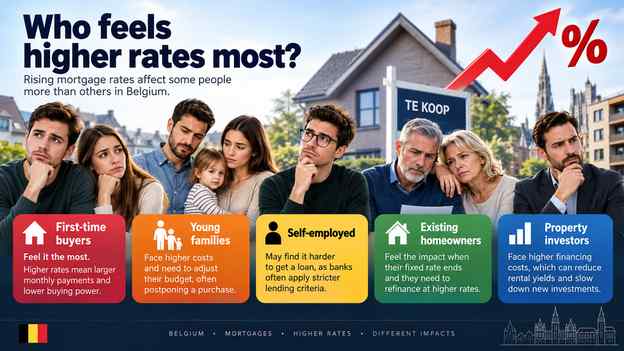
First-time buyers
First-time buyers are generally the most exposed because they have less existing equity. A higher rate can force them to:
- Save for a larger deposit
- Choose a smaller or older property
- Move farther from major cities
- Accept a longer mortgage term
- Delay buying while building savings
They should calculate the complete purchase budget, including registration duties, notary fees, insurance, renovation and energy upgrades.
Existing homeowners
Owners with fixed-rate mortgages are less exposed to immediate payment increases. However, they may face affordability problems if they move house and need a new loan at today’s rate.
Households with variable-rate loans should check the adjustment formula and the contractual reference index. Belgium’s Federal Public Service Economy publishes monthly reference indexes used for variable mortgage-rate adjustments. Belgian reference indexes
Buy-to-let investors
Investors must consider the relationship between rent, operating costs, taxes and financing. A property that produced an acceptable yield at 1.5% borrowing cost may no longer work at 3% or 4%. Higher rates can therefore reduce investor demand even when owner-occupier demand remains firm.
Could higher rates eventually cause a larger price correction?
Yes, but it would probably require several pressures to occur together:
- Mortgage rates staying high for an extended period
- Unemployment rising significantly
- Real wages failing to keep pace with inflation
- Banks tightening lending standards
- A large increase in forced sales
- New construction and housing supply rising quickly
Belgium currently has important shock absorbers: fixed-rate borrowing, wage indexation, household savings and limited supply. These factors favour a gradual adjustment rather than an abrupt nationwide collapse.
However, resilience does not mean every property will hold its value. Energy-inefficient homes, poorly located properties and heavily renovated apartments may face greater discounts because buyers must budget for expensive upgrades. Prime locations with transport access and strong employment demand may remain comparatively defensive.
Practical advice for buyers in 2026

Start with a conservative affordability calculation. Keep the mortgage payment comfortably below the maximum offered by a lender, and stress-test the budget against higher energy bills, childcare, repairs and temporary income loss.
Compare several banks and brokers. Belgian mortgage pricing depends on loan-to-value ratio, income stability, property energy performance, insurance products and the size of the borrower’s deposit.
Do not assume that waiting for lower rates automatically guarantees a better deal. If rates fall, more buyers may return to the market, potentially pushing prices higher. If prices soften, financing could remain expensive. The right decision depends on your income security, time horizon and cash reserves.
Fixed-rate loans offer payment certainty, while variable-rate products may start cheaper but carry adjustment risk. Read the cap, revision frequency and reference index carefully before signing.
Hypotheekmarkt België: FAQ
Are higher mortgage rates causing Belgian house prices to fall?
They have reduced affordability and cooled parts of the market, but official data still showed annual house-price growth of 2.0% in Q1 2026. The impact has been more visible in borrowing capacity and transaction activity than in a nationwide price crash.
What is the typical Belgian mortgage rate now?
The NBB reported that household mortgage rates were just above 3% in May 2025 after declining from around 4%. Actual offers in 2026 vary by lender, term, fixed period, loan-to-value ratio and borrower profile, so applicants should request personalised quotes.
Is a fixed-rate mortgage safer in Belgium?
A fixed rate provides predictable payments and protects borrowers from future increases. It may start at a higher rate than a variable loan, but the certainty is valuable for households with limited monthly flexibility.
Which Belgian region is cheapest for homebuyers?
Wallonia generally has the lowest median prices. For 2025, Statbel recorded median prices of €198,000 for attached or semi-detached houses and €325,000 for detached houses in Wallonia.
Should buyers wait for mortgage rates to fall?
Waiting can make sense if your finances are not ready, but rate forecasts are uncertain. A future rate cut could also bring more competition and higher prices. Base the decision on affordability, emergency savings and how long you expect to own the property.
Do higher rates affect new-build homes differently?
Yes. Construction financing and buyer affordability both suffer when rates rise. New-build prices may be supported by land, labour and material costs, even when demand weakens, which can limit the size of discounts.
Final outlook
The Belgian mortgage market is adjusting to a world of more expensive credit. Higher rates have made buying a home harder, particularly for first-time buyers and investors, but they have not automatically translated into falling prices across the country.
The most likely near-term outcome is a segmented market: modest overall price growth, selective discounts for weaker properties and stronger resilience in supply-constrained locations. For Indian readers tracking European property conditions, the key lesson is universal: interest rates influence what buyers can pay, but housing prices are ultimately shaped by the interaction of credit, income, supply and local demand.