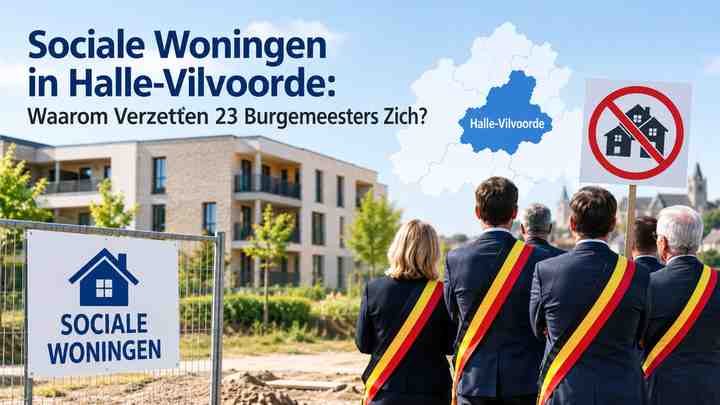
The dispute over sociale woningen in Halle-Vilvoorde has escalated into a legal challenge. On 10 September 2026, 23 mayors from the Flemish Rand around Brussels announced that they would take the Flemish government’s social-housing target to Belgium’s Council of State.
The mayors, united through the cross-party Toekomstforum Halle-Vilvoorde, say they are not against social housing. Their objection concerns how the targets are calculated, the pressure created by migration from Brussels, limited building land and the financial penalties attached to missed targets.
At the heart of the issue is the Bindend Sociaal Objectief (BSO), or Binding Social Objective. This Flemish policy determines how many social homes each municipality must provide by a set deadline. For the mayors, the current formula places an unrealistic burden on a region already facing high land prices and rapid population growth.
What is the BSO?
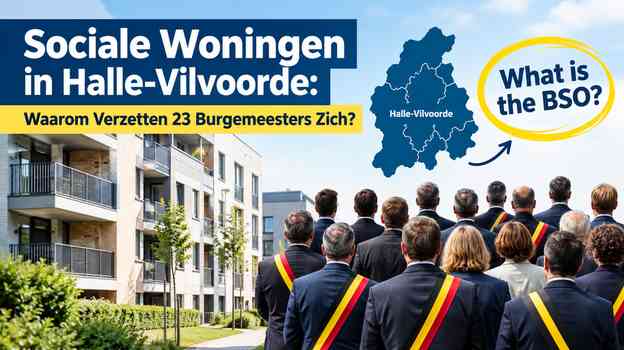
The BSO is a housing obligation imposed on municipalities in Flanders. It sets the number of additional social homes that each local authority is expected to realise. Progress is checked through a review every three years.
The policy is intended to spread social housing more evenly across Flanders. Municipalities that historically had fewer affordable or publicly supported homes are expected to increase their supply. The broader aim is to give low-income households, people with disabilities, older residents and families in housing difficulty better access to secure accommodation.
The system uses demographic and housing indicators to estimate future demand. However, the Halle-Vilvoorde mayors argue that the formula does not adequately distinguish between different regions.
Their concern is particularly strong in municipalities near Brussels, where population growth is influenced not only by local births and household formation but also by people moving out of the Brussels-Capital Region.
Why are 23 mayors opposing the targets?
1. Brussels-related migration is increasing projected demand
According to the mayors, the BSO calculation includes external population growth linked to migration from Brussels. Jan Desmeth, mayor of Sint-Pieters-Leeuw and chair of the Toekomstforum, says the resulting growth forecast for the Flemish Rand is about 60% higher than the Flemish average.
The mayors believe this makes the social-housing obligation unusually high for Halle-Vilvoorde. They argue that the Brussels-Capital Region should take greater responsibility for its own housing shortage instead of transferring much of the pressure to surrounding Flemish municipalities.
This is not a claim that every person moving from Brussels needs social housing. Rather, the mayors say that the broader migration pattern affects demand for homes, public services, schools and integration support in the Rand.
2. Building land is scarce
Halle-Vilvoorde is located next to Brussels, one of Belgium’s most expensive and densely developed urban areas. Open land is limited, and construction is affected by planning rules, environmental restrictions and existing development.
The region must compete for land needed for multiple public purposes, including:
- Social and private housing
- Schools and childcare facilities
- Roads and public transport
- Healthcare and community services
- Green spaces and flood management
The mayors say that applying the same housing-growth expectations used elsewhere in Flanders ignores these physical limitations. A municipality may technically have a target, but that does not mean it has enough suitable land to deliver the required number of homes.
3. Construction costs are higher
Land prices in the Brussels periphery are generally higher than in less pressured parts of Flanders. That makes every social-housing project more expensive before construction even begins.
Higher costs can affect the size, design and timing of developments. Social-housing providers may need additional subsidies, cheaper public land or partnerships with private developers to make projects financially viable.
Koen Van Elsen, one of the forum’s vice-chairs, argues that these factors make the BSO more difficult to achieve in the Rand than in municipalities with greater land availability and lower property prices.
4. Municipalities face penalties, even when housing companies build the homes
Another major objection concerns accountability. Social homes are usually developed and managed by recognised housing companies, known in Flanders as woonmaatschappijen. Municipalities help with planning, land policy and coordination, but they do not control every stage of construction.
The mayors nevertheless say local authorities risk financial penalties if they fail to meet BSO targets. In their view, this creates an unfair arrangement: municipalities carry the legal and financial consequences, while housing companies handle much of the practical delivery.
They want the legislation to reflect the responsibilities of all parties involved and to account for regional constraints before penalties are imposed.
Are the mayors against social housing?
No. This distinction is central to the dispute.
The 23 mayors have stressed that every municipality involved already has projects aimed at adding social homes. Their argument is that the region needs a more realistic and locally tailored target, not that social housing should stop.
Halle-Vilvoorde actually has a relatively small social-rental housing stock compared with several other Flemish regions. A 2024 memorandum from regional development organisation Haviland reported fewer than four social rental homes per 100 private households in Halle-Vilvoorde, placing the area near the bottom of the Flemish comparison.
That shortage means the region faces two pressures at the same time: it needs more affordable homes, but it also has less land and higher development costs than many other areas.
What are the mayors asking for?
The Toekomstforum’s main request is to remove Brussels-related migration pressure from the BSO calculation for the Flemish Rand.
Instead of using the higher regional growth forecast, the mayors want the Flemish average to be used as the planning assumption. They believe this would produce targets that are more achievable while still allowing municipalities to expand social housing.
They also want the calculation to consider:
- Scarcity of developable land
- Local planning restrictions
- Construction and land costs
- Existing social-housing capacity
- The division of responsibilities between municipalities and housing companies
- The regional impact of population movement from Brussels
The Flemish government has already granted a reduction to the BSO for the Flemish Rand. However, the mayors say that reduction does not go far enough.
Which municipalities are involved?
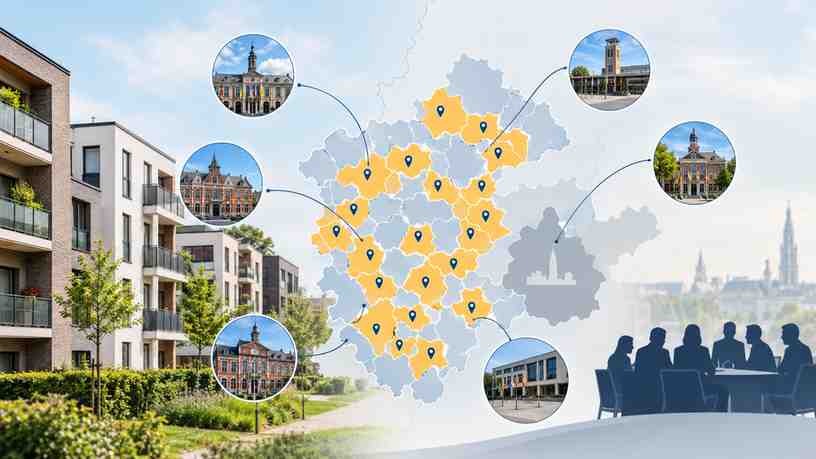
The appeal is supported by mayors from 23 local authorities:
Affligem, Asse, Beersel, Dilbeek, Drogenbos, Grimbergen, Halle, Hoeilaart, Kampenhout, Kraainem, Lennik, Liedekerke, Meise, Merchtem, Opwijk, Overijse, Roosdaal, Sint-Pieters-Leeuw, Steenokkerzeel, Ternat, Vilvoorde, Zaventem and Zemst.
Together, these municipalities represent a substantial part of the Halle-Vilvoorde region, which has more than 660,000 residents.
The political cooperation is also notable. The mayors belong to different parties but have joined forces through the Toekomstforum to challenge a policy they believe fails to reflect local realities.
Examples of the pressure
The targets differ by municipality. Earlier reporting cited proposed additional requirements of approximately 622 homes for Grimbergen, 564 for Halle, 525 for Vilvoorde and 504 for Sint-Pieters-Leeuw.
These figures are additional targets, not the total number of social homes already present. Halle, for example, already has a substantial social-housing stock, yet the proposed increase would still require hundreds of new units.
Projects can be delivered through new construction, renovation, conversion of vacant buildings or agreements with private developers. Halle-Vilvoorde has already experimented with alternatives such as converting empty properties into energy-efficient social homes through regional initiatives.
However, the mayors argue that these approaches cannot fully compensate for limited land and rising costs.
What does the Flemish government say?
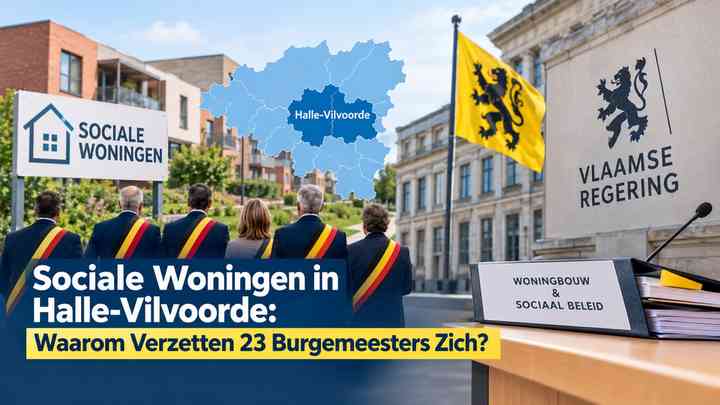
The legal challenge has drawn criticism from Flemish Housing Minister Melissa Depraetere, who reportedly described the move as “incomprehensible”.
The government’s position is based on the need to increase social housing across Flanders. Supporters of the BSO can argue that regional growth also means growing demand for affordable homes, regardless of where new residents previously lived.
From this perspective, municipalities near Brussels benefit from economic activity and population growth and should contribute to housing solutions. Reducing targets could also shift pressure to other Flemish areas that already face long waiting lists.
The Council of State will now be asked to examine the legal and administrative basis of the targets. Filing an appeal does not automatically suspend the BSO or cancel existing obligations.
What happens next?
The Council of State will assess the mayors’ arguments and the legality of the calculation method. Possible outcomes include rejection of the appeal, a request for adjustments, or a decision requiring the Flemish government to reconsider part of the framework.
The case could influence how regional population growth is treated in future housing policy. It may also affect the way responsibilities are divided between municipalities, housing companies and higher levels of government.
For residents, the immediate situation remains unchanged. Social-housing applicants must continue using the applicable Flemish registration system and local housing companies. Organisations such as Providentia operate in parts of Halle-Vilvoorde, while other woonmaatschappijen serve neighbouring areas.
Why this debate matters
The argument over sociale woningen in Halle-Vilvoorde reflects a wider policy dilemma: how can governments distribute housing obligations fairly when regions face very different conditions?
Halle-Vilvoorde needs more affordable homes. At the same time, it faces expensive land, limited space, strong demographic pressure and the spillover effects of Brussels’ housing market.
The 23 mayors are therefore challenging the method and scale of the obligation rather than the principle of social housing itself. Their case asks whether one formula can fairly serve dense urban edges, rural municipalities and major cities alike.
The final decision will determine whether the current BSO remains in place or whether the Flemish government must develop a more region-sensitive approach.
Frequently asked questions
What does “sociale woningen” mean?
“Sociale woningen” is the Dutch term for social housing. These are homes rented or sold under regulated conditions to households that meet income and eligibility requirements.
What is the Bindend Sociaal Objectief?
The Bindend Sociaal Objectief, or BSO, is the Flemish government’s binding target for the number of social homes municipalities must provide by a specified deadline.
Are the 23 mayors refusing to build social housing?
No. They say their municipalities are already working on social-housing projects. Their objection is that the current BSO targets do not adequately account for migration pressure, land scarcity and construction costs.
Why is Brussels mentioned in the dispute?
The mayors say population movement from Brussels into the Flemish Rand increases projected growth in Halle-Vilvoorde. They want Brussels-related migration pressure excluded from the formula used to calculate their social-housing targets.
Could the dispute affect people waiting for a social home?
Not immediately. Existing registration and allocation procedures continue. The legal case could influence future construction targets, but it does not automatically remove current waiting-list rights or applications.
What is the Council of State being asked to decide?
The Council of State will examine the mayors’ legal challenge to the BSO framework and its application to Halle-Vilvoorde. It has not yet ruled that the targets are unlawful.